
You Already Know This Wood
If you went to school anywhere in America before the mid 1990s, you sat at a white oak desk. You walked on white oak floors. The trim in the hallways, the cabinets in the library, the pews at church on Sunday, the judge’s bench at the courthouse downtown, all of it was white oak. It was everywhere because it was the American hardwood. Tough, available, affordable, and it looked good doing all of it. Your grandma’s dining table that she never let anyone put a glass on without a coaster was probably white oak. Nobody talked about it because nobody had to. It was just what things were made out of.
That is not the conversation anymore. Good quality white oak plywood is running $200 to $1,000 a sheet right now depending on where you source it and how picky you are about the face veneer. Rough sawn quarter sawn lumber is anywhere from $12 to $19 a board foot, and good rift sawn stock can push past that. The wood that used to build elementary school hallways is now a luxury material, and the price reflects it. How we got from there to here is part of what makes white oak so interesting to me.

White oak. The wood that built America and then quietly became a luxury material.
The Wood That Built Mid-Century America
White oak has been in American furniture and architecture for centuries, but it really hit its stride in the early 1900s. Gustav Stickley and the Arts and Crafts movement made quarter sawn white oak famous because the ray flecks in the grain were part of the design, not something you sanded through trying to hide. Frank Lloyd Wright used it in his Prairie style interiors because it was stable, took stain beautifully, and had a warmth that matched the horizontal lines he was after. Those designers were not reaching for white oak because it was trendy. They were reaching for it because the wood did exactly what they needed it to do.
Then mid-century modern happened, and white oak became the default. All those clean Scandinavian-inspired lines, the warm natural tones, the low furniture with tapered legs and open grain, that was white oak. It showed up in everything from dining sets to credenzas to wall paneling. And because it was domestic and plentiful, it was accessible. A middle class family could afford a solid white oak dining table. A school district could spec white oak flooring and trim for every building in the system and stay on budget.
Then somewhere in the late 70s and 80s, red oak took over. Builders loved it because it was cheaper and even more available, and it became the default for cabinets, flooring, and trim in residential construction. If you have ever walked into a house built between 1985 and 2005 and thought “everything is orange,” that was red oak with a polyurethane finish doing what red oak with a polyurethane finish does. White oak never disappeared from high end work, but it dropped out of the mainstream for about 20 years.
Now it is back, and the demand has pushed the price to where it sits today. Interior designers figured out what woodworkers never forgot, that white oak has a cleaner, more neutral grain than red oak, takes modern finishes like oil and hardwax better than almost anything else, and fits the natural, warm aesthetic that has been dominating residential design since 2015 or so. The supply has not kept up with the demand, and that is a $1,000 a sheet problem for us builders.
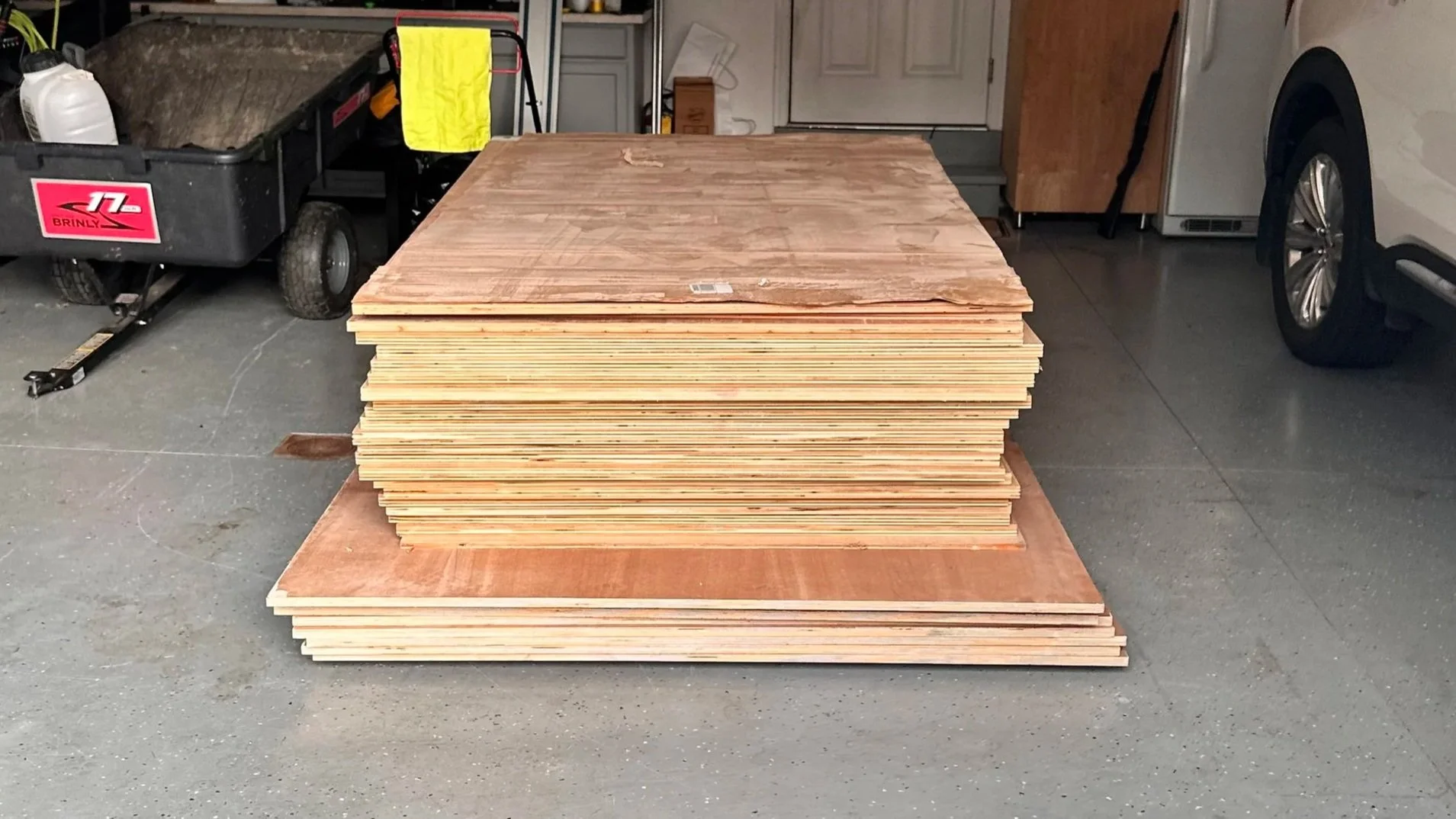
30 sheets of architectural grade rift sawn white oak plywood staged for the closet build.
Why I Keep Reaching for It
I build handcrafted furniture and luxury home decor, and white oak is probably 20 to 30 percent of what comes through my shop in a given year. Not because I set out to be a white oak guy, but because it keeps being the right answer for the work I do.
It machines beautifully. Clean cuts on the table saw, clean cuts on the track saw, and it holds a crisp edge on routed profiles without the fuzzy tearout you get with softer species but you do get blowout if you go too fast. I use it a lot for table legs with contrasting tops like walnut. It’s beautiful and understated and you can bang the vacuum off of it occasionally without worry. When I make hand cut mortises or even use the Domino for joinery, the mortises come out tight and the walls of the cut are smooth, which matters because a sloppy mortise means a sloppy joint no matter how much glue you throw at it. On the Festool Domino, the 8mm by 40mm tenon in white oak is about as strong a joint as you can make on a piece of furniture without going to traditional mortise and tenon. The wood is hard enough that the tenon walls hold up under stress, but it is not so hard that you are fighting the machine to get a clean cut. If you want to know more about why the Domino earns its spot in my shop, I wrote about that here.
It sands predictably, which sounds boring but matters when you are trying to get a consistent finish across a large project. I can take it from 120 to 220 grit without spending an hour chasing swirl marks or worrying about the grain raising unevenly. And it takes oil finishes better than almost any other domestic hardwood I have worked with, which brings me to the real reason I love this wood.
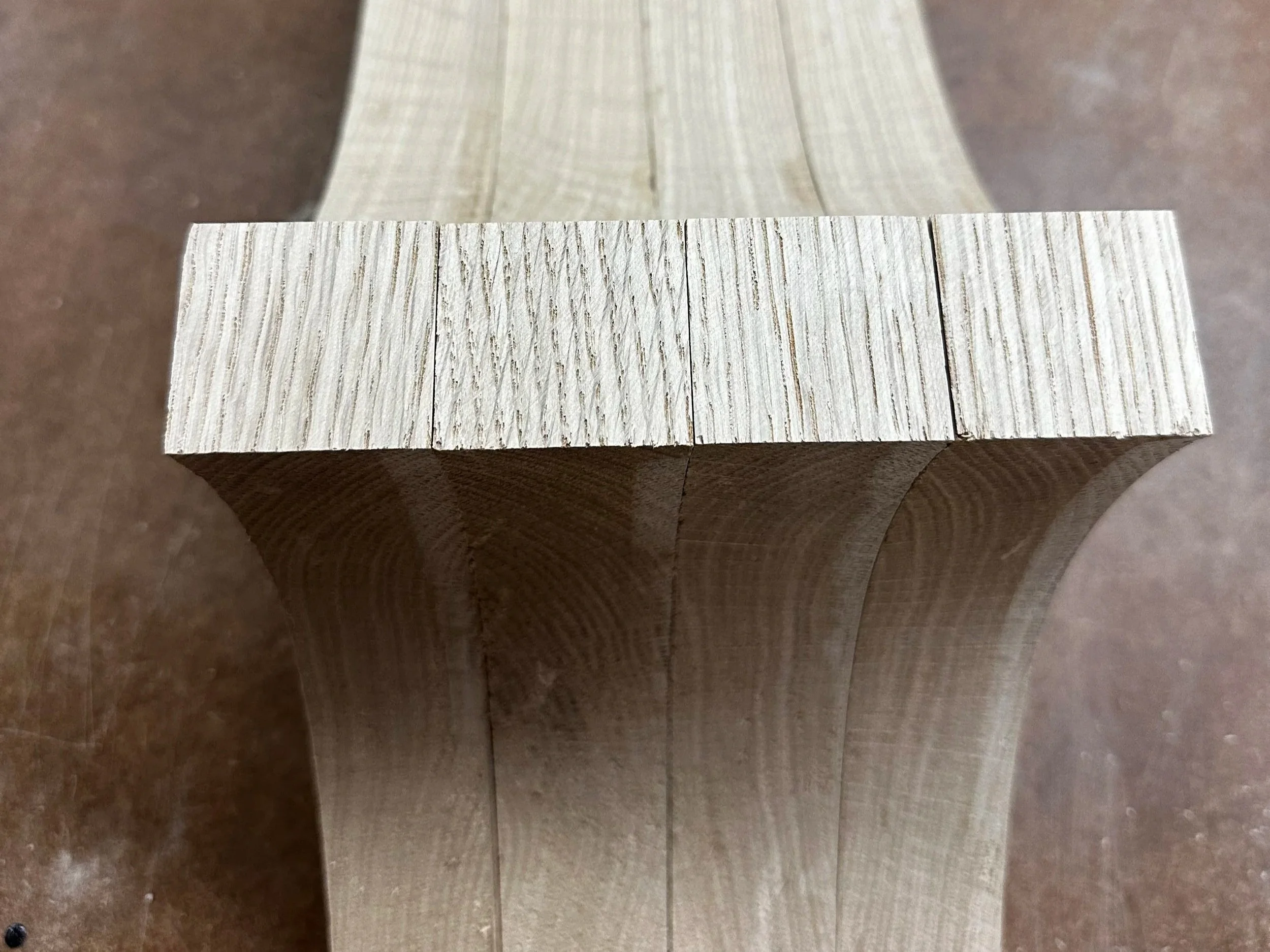
Domino mortise in white oak. Clean walls, tight fit.
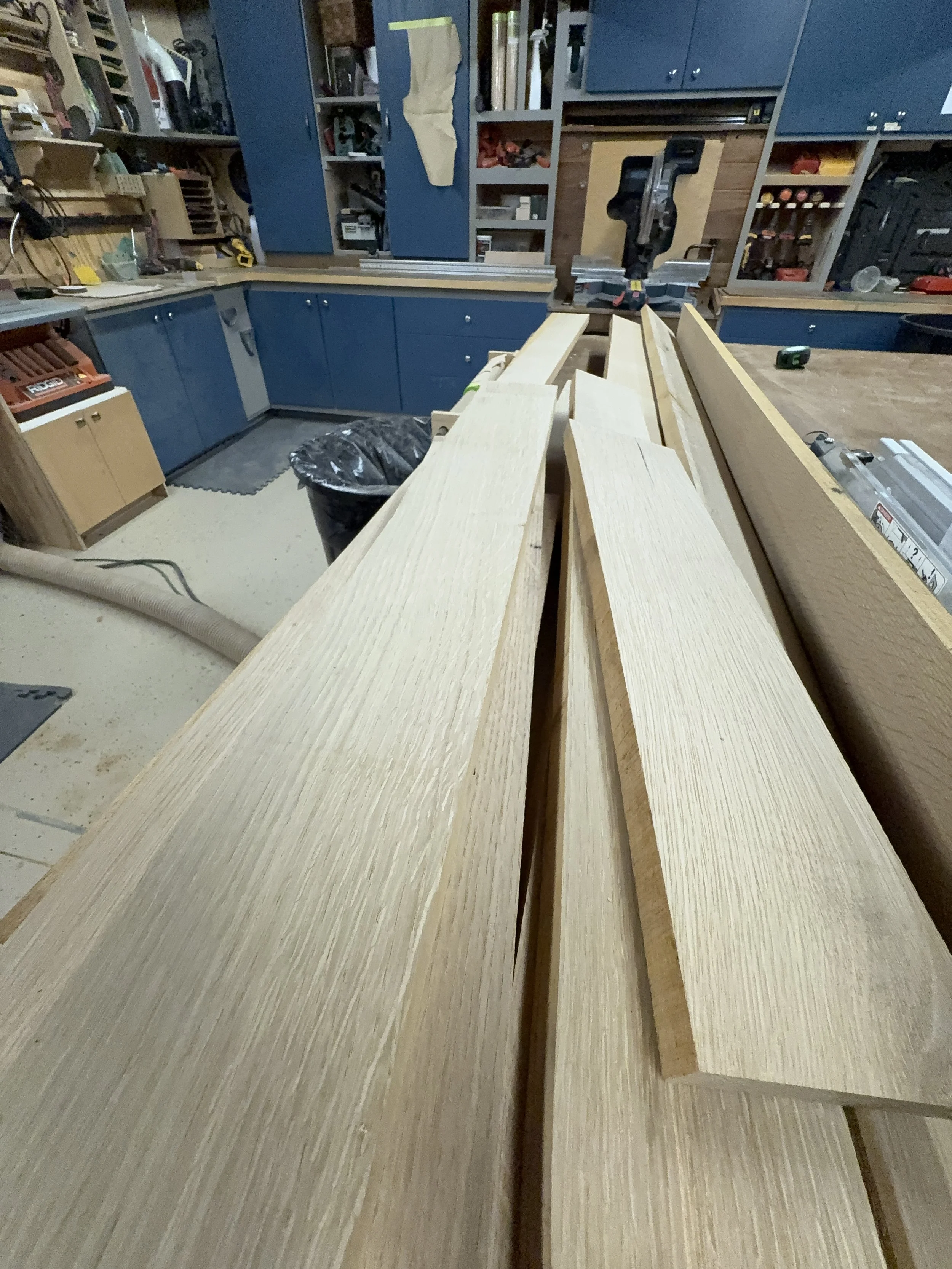
White oak boards stacked in the shop between milling and install.
Cut Types and Why They Actually Matter
There are three ways to mill white oak, and each one gives you a completely different looking and behaving piece of wood. Most of the internet explains this with a diagram of a log cross section and some arrows, which is fine, but what actually matters is how each cut looks on a finished project and why you would choose one over the other.
Flat sawn is the most common and the cheapest. The grain has a cathedral pattern, those big arching lines that are distinctive and sometimes beautiful but tend to look busy on large flat surfaces. I use flat sawn mostly on legs and projects where it’s milled in a way that all four sides have about the same visibility. There is no reason to waste money on quarter sawn when you end up with two flat sawn faces anyhow. For the closet project I did, flat sawn was not an option because 250 square feet of cathedral grain would have looked like a bowling alley.
Quarter sawn is cut perpendicular to the growth rings, and this is where white oak gets its reputation. The ray flecks that show up in quarter sawn white oak are unique to the species, these shimmery, almost iridescent lines that run across the grain. Stickley used them as a design feature 120 years ago and they are still one of the most striking things in hardwood. I use quarter sawn for table tops, visible furniture faces, and anything where the wood is the focal point. It is more stable than flat sawn, meaning it moves less with humidity changes, and it costs more because the yield from each log is lower.
Rift sawn is the most expensive cut and the one I chose for the closet cabinetry. The grain lines are tight, straight, and uniform with no cathedral pattern and no ray flecks. It looks modern, clean, and consistent across large surfaces, which is exactly what you want when you are paneling an entire room in the same species. The reason it costs so much is that rift sawing wastes more of the log than any other method. You are paying for the look, but you are also paying for the material that ended up on the saw mill floor. For a 250 square foot closet where every panel has to match, rift sawn was the only thing that made sense, and the price tag reflected it.
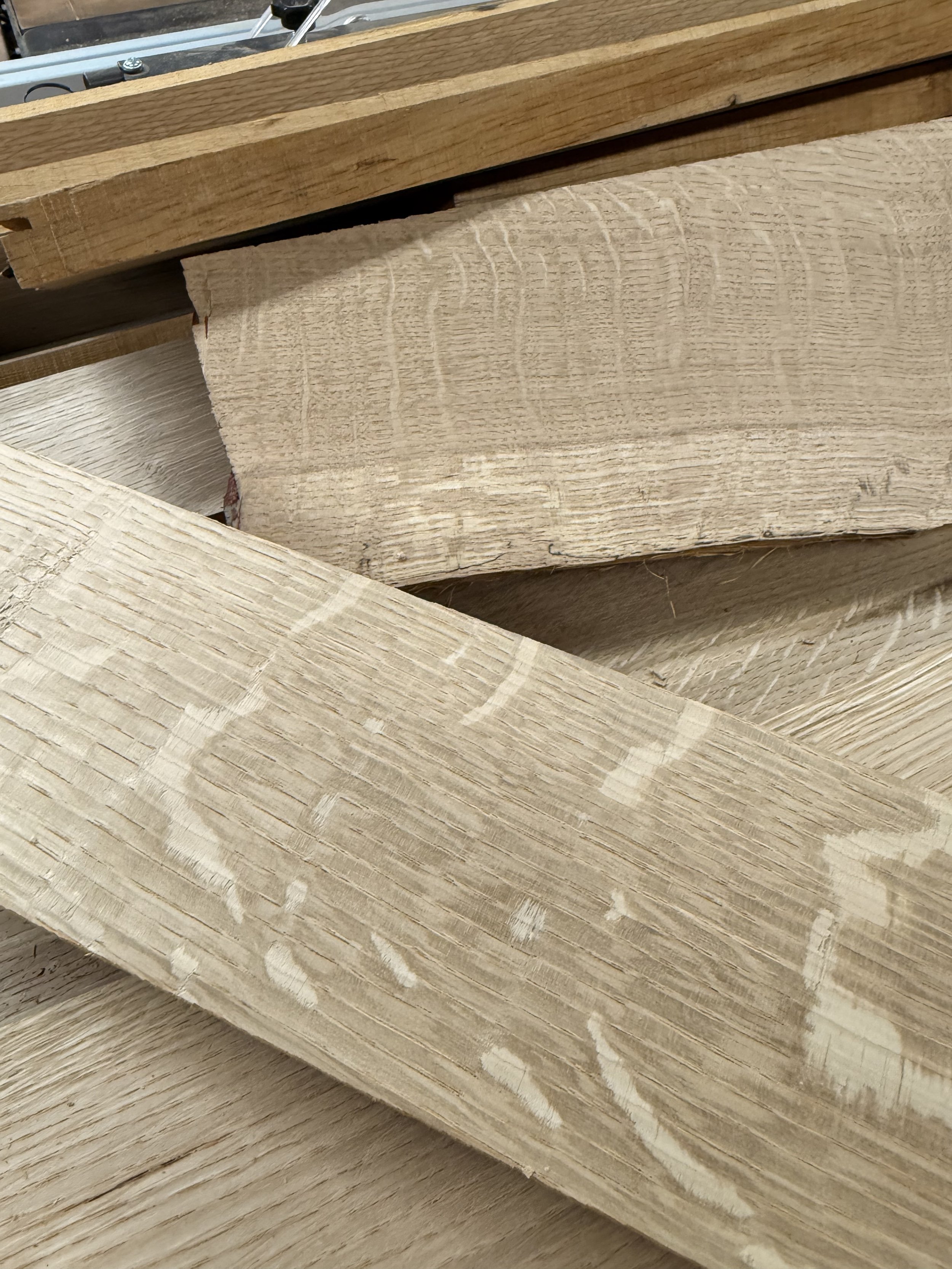
Quarter sawn white oak. The ray flecks are what made this species famous.
Finishing White Oak
This is where white oak separates itself from almost every other domestic hardwood, and it is honestly the main reason I keep reaching for it on projects where the finish matters.
My go-to finish for non-food white oak projects is Osmo Polyx-Oil. I call it ranch dressing for wood because I put it on everything. On white oak specifically, it does something that is hard to describe until you see it in person. The oil soaks into the open grain and brings out the natural warm tone of the wood without pushing it yellow or orange the way polyurethane does. The satin sheen looks like the wood is naturally that smooth, not like someone sprayed a coating on top of it. One coat on a well-sanded piece of white oak will make you wonder why anyone ever used polyurethane on hardwood.
I also use Rubio Monocoat, and on white oak it is a different experience than Osmo but equally good. Rubio is a single coat finish, one application and you are done, and it bonds to the wood at a molecular level rather than sitting on top. The Rubio White 5% tint on quarter sawn white oak is one of the best looking finishes I have ever put on anything and why it was used in the closet project. It lightens the wood just enough to let the ray flecks pop without looking bleached or artificial. If you are building anything where you want the white oak to stay light and natural looking, that is the combination.
One thing to know about finishing white oak is that the tannin content in the wood affects how it responds to certain products. White oak has a lot of tannic acid, which is actually why it was traditionally used for whiskey barrels and boat building, the tannins make it naturally resistant to water and decay. But those same tannins can react with water based finishes and turn the surface gray or blotchy if you are not careful. That is another reason I stick with oil based finishes or hard wax on white oak. The oil works with the tannins instead of fighting them, and the result is a finish that looks like the wood is supposed to look.
For the closet project, I went with Rubio White across all 250 square feet because I needed a finish I could apply consistently on a large surface area without worrying about lap marks or uneven sheen. Osmo would have worked too, but the client liked the White Rubio better and so did I. One coat, let it sit for a few and buff off with a white Scotch-Brite and then I go back over with a microfiber cloth to pull off any excess and the whole thing looks like it belongs in a magazine.
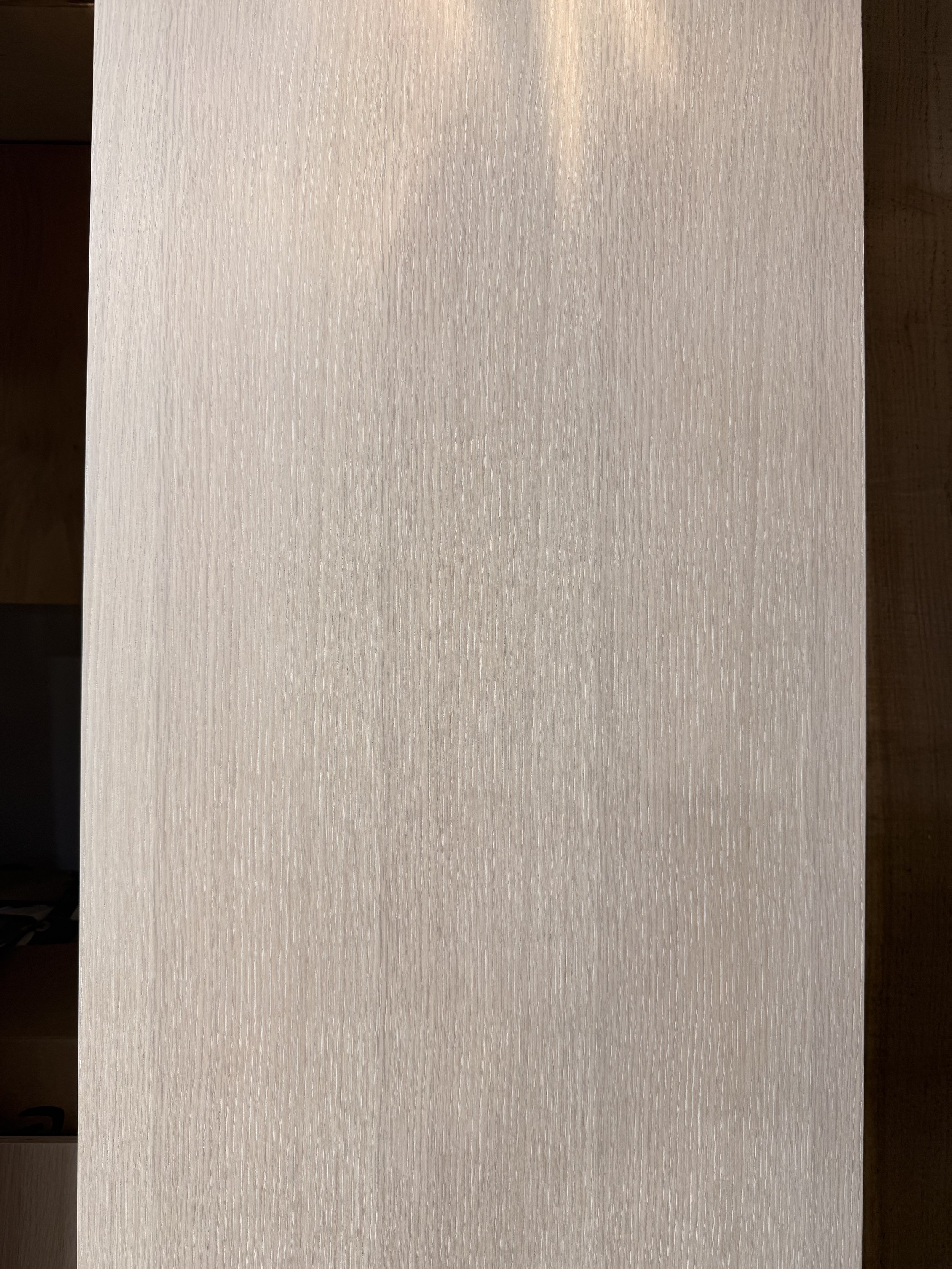
Rift sawn white oak plywood with Rubio Monocoat White 5%. One coat.
Where White Oak Will Humble You
I am not going to write a white oak sales pitch because this species has real downsides that you need to know about before you commit $25,000 in material to a project.
The weight is no joke. White oak is about 47 pounds per cubic foot dried, which puts it in the heavy category for domestic hardwoods. A one inch 4x8 sheet of white oak plywood weighs close to 90 pounds and a rough sawn board 8 feet long and 8 inches wide at 4/4 thickness is going to be around 25 to 30 pounds. You notice it instantly when you pick it up, it feels heavier than it should. Multiply that by a full project and your body knows it. After a full day of milling lumber, my shoulders and lower back are toast. This is a species that makes you plan your workflow around how much lifting you can do in a day, and if you are working alone, that is a real constraint.
The cost has gotten out of hand. I said it earlier but it is worth repeating. White oak was a blue collar wood for most of the 20th century, and now it is priced like a luxury material. Rift sawn plywood at $800 to $1,000 a sheet, quarter sawn lumber at $15 to $20 a board foot, even flat sawn is running $8 to $12 a board foot at most hardwood dealers. If you are building a large project, you need to factor material cost into the quote very carefully because a miscalculation on quantity can blow your margin fast.
Tannin bleed is real and it will ruin your day if you are not paying attention. The tannic acid in white oak reacts with ferrous metals, meaning iron and steel, and turns the wood black on contact. Regular steel clamps left on a wet glue-up will leave black marks that do not sand out easily. Steel hardware in direct contact with the wood will stain it over time. Even a wet steel bolt sitting on a white oak surface for an afternoon will leave a mark. Use stainless steel hardware, plastic clamp pads, or wax paper between your clamps and the wood. I learned this one the hard way, at least a dozen times.
The dust will get you. White oak dust is fine, pervasive, and hard on the lungs. The tannins that make the wood durable also make the dust irritating, and if you are doing a heavy milling or sanding session without proper dust collection and a respirator, you are going to know it by the end of the day. I run a 2HP collector through a cyclone separator, plus a Bosch dust extractor on the track saw and sanders, and I still end up with a film of white oak dust on everything after a big session. A WEN 3410 air filtration unit runs in the background to catch what the collection misses. Take the dust seriously, especially on extended projects.
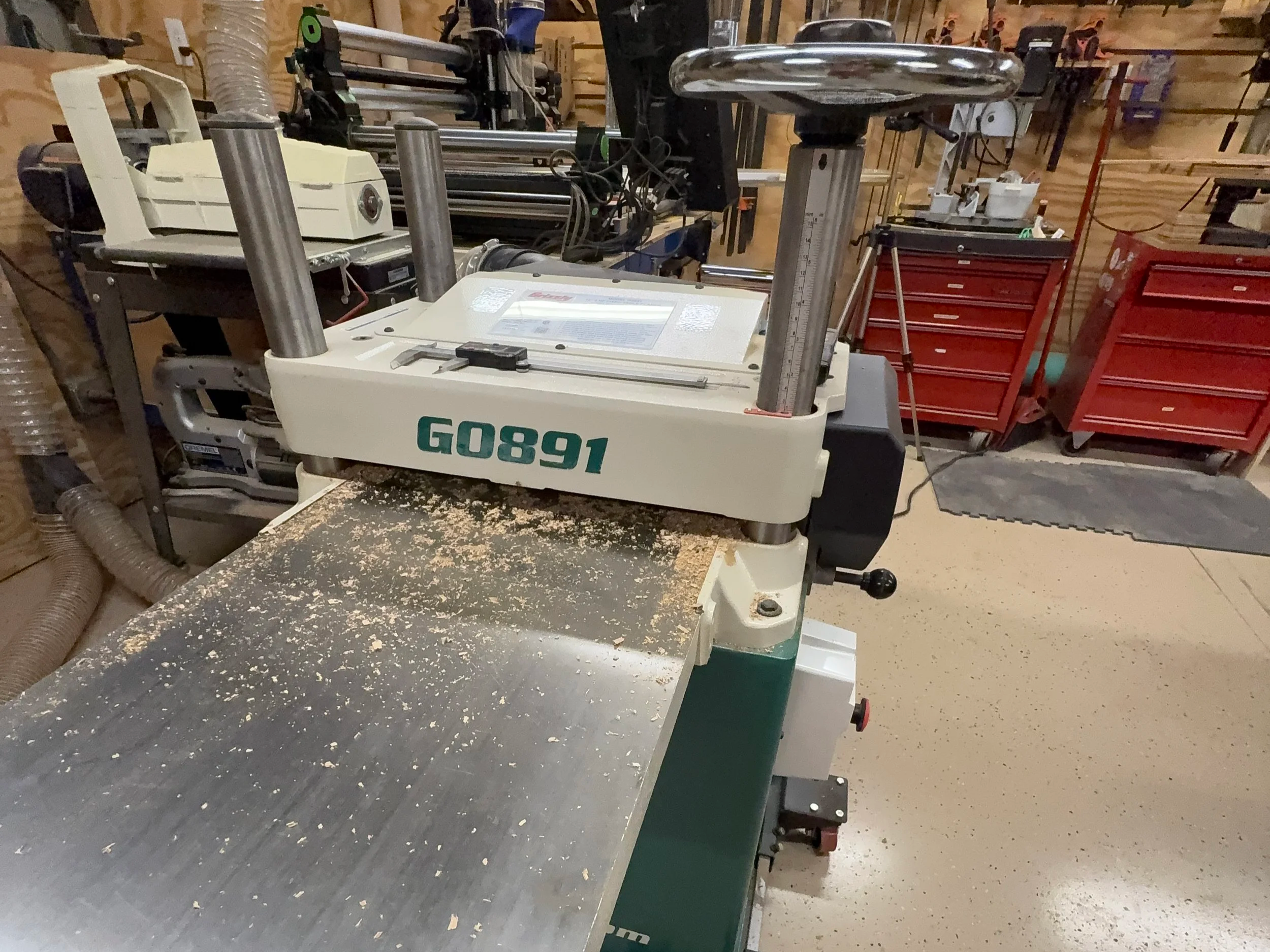
White oak shavings after a milling session. The dust is worse than it looks.
Still the Standard
White oak was the American hardwood for the better part of 150 years because it did everything well and it did not need a marketing team to convince people of that. Schools used it because it could handle thousands of kids and still look good 50 years later. Furniture makers used it because it machined clean, took finish well, and held joints tight. Barrel makers used it because nothing else kept the whiskey in and the water out.
The fact that it now costs what it costs does not change what it is. It just means you plan more carefully, measure twice, and try not to scrap a $40 piece of lumber because you grabbed the wrong line on the cut list. I have been working with white oak for most of my career and the closet build confirmed what I have always thought about it, everyone that sees it says it looks like a high-end boutique. It has institutional gravitas and shocking beauty. It looks unassuming and standard until you get close and then it pulls you in. I still see pieces that make me think “how the hell does it do that.” When you need a wood that machines well, finishes beautifully, and is going to last longer than you will, white oak is still the answer. It just costs more to get there than it used to.
For everything I use in the shop on white oak projects and beyond, you can see the full list on my Tool Room page.
Products Referenced in This Post
Osmo Polyx-Oil — my go-to non-food finish on white oak and most furniture projects, two coats for a natural satin look that holds up
Rubio Monocoat — single coat oil finish, the White 5% tint on quarter sawn white oak is one of the best looking combinations I have used
Festool Domino — loose tenon joinery system, the 8mm by 40mm tenon in white oak makes an incredibly strong furniture joint
Bosch Dust Extractor — HEPA filtration and auto filter clean, I run this with the track saw and sanders when working white oak
Makita Plunge Circular Saw Kit with 55 inch Guide Rail — the track saw I used to break down 30 sheets of rift sawn white oak for the closet build
White Non-Woven Scuff Pads — what I use to buff Rubio Monocoat after application, gentler than sandpaper with consistent results
Microfiber Cleaning Cloths — for pulling excess finish off after buffing, lint-free and cheap in bulk
Affiliate Disclosure: This post contains affiliate links. If you purchase through these links, I may earn a small commission at no additional cost to you. I only recommend products I personally use in my shop.