
Your Walnut Doesn't Look the Way It Did When You Bought It
Affiliate Disclosure: This post contains affiliate links. If you purchase through these links, I may earn a small commission at no additional cost to you. I only recommend products I personally use in my shop.
I didn't believe this either until I pulled two pieces I'd milled from the same log. One had been sitting on my kitchen counter for three years. The other had been buried in a dark corner of the shop the whole time. Held them side by side and they looked like two different species. The counter piece had lightened toward amber and honey. The shop piece still had the rich chocolate I remembered milling.
The thing I used to tell clients, that walnut only gets richer with age, turns out to be wrong. Walnut lightens. Sun and oxygen accelerate it. And once I noticed, I went way too deep trying to figure out what else I'd been getting wrong about this wood. I ended up buying Blacktail Studio's Nano protection and putting it on the Milo table, which sits right next to a window in my house. Live test, running right now.
This is the walnut deep dive. History, cut types and selection, why it finishes like almost nothing else, the UV question I'm actively testing, and the honest downsides, including a few I don't love admitting.
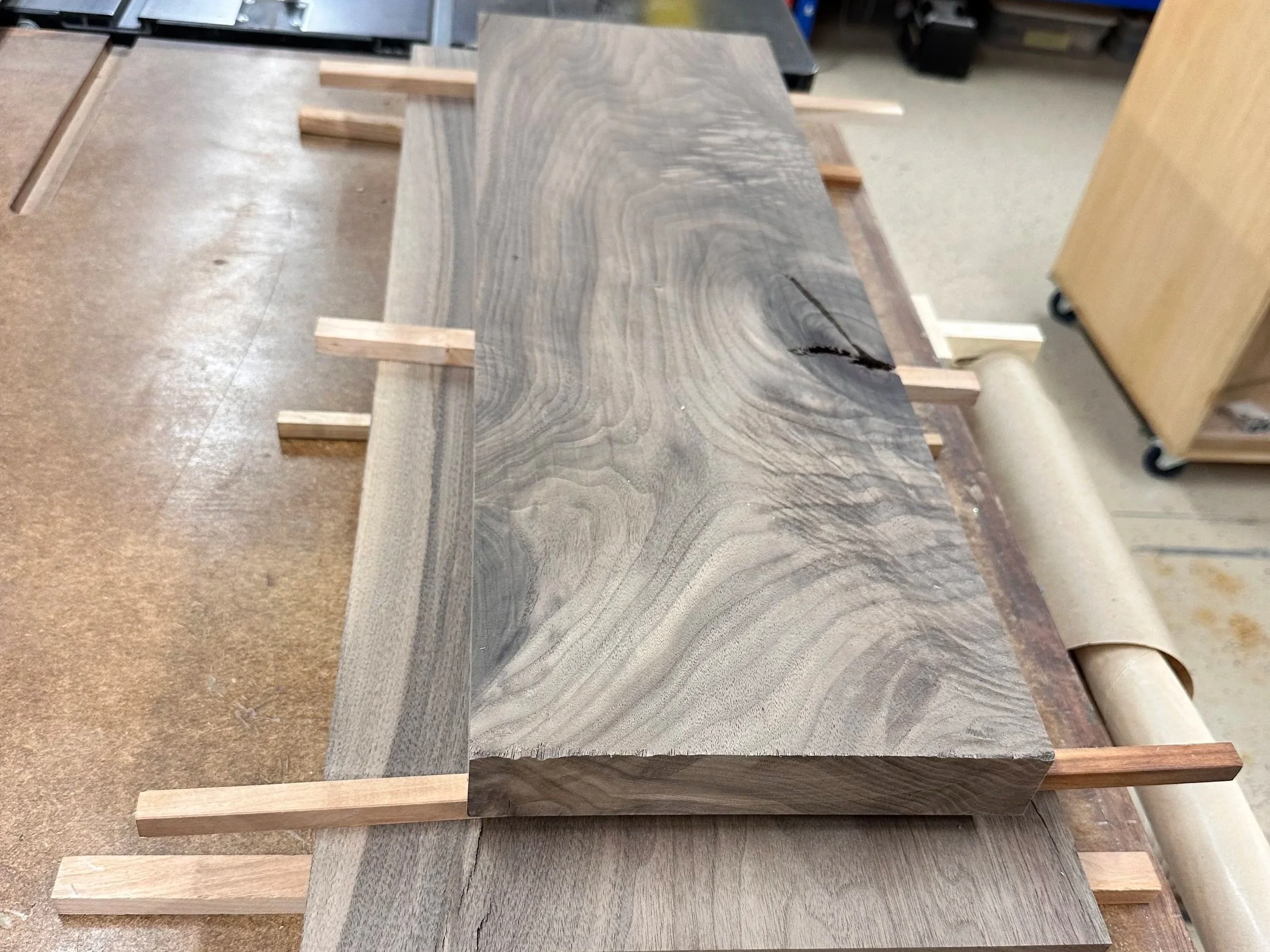
A walnut slab before any finish touches it. This is the color you think you're buying. Stick around for what it becomes.
The Wood That Built Mid-Century Modern
Walnut has been in American furniture since the 1700s, but the moment that matters is the mid-century modern surge. George Nakashima, Sam Maloof, Hans Wegner, George Nelson. Every iconic chair, every credenza, every statement dining table from that era was either walnut or trying to look like walnut. There's a reason the Nakashima Conoid chair is still priced like a down payment on a house. Walnut earned it, and not as the workhorse. Oak did the workhorse duty, maple was the budget pick. Walnut was the wood that signaled you cared about craft. That status has never left it
Why walnut specifically? Because walnut sits in a narrow middle zone on three dimensions that no other American hardwood hits at once.
Color. Walnut lives in warm brown with purple and gold undertones, the part of the color spectrum the eye reads as warmth biologically. But the grain is mostly straight, not the cathedral sweep of oak or the knottiness of pine. Warm plus clean equals refined. Oak reads traditional, pine reads rustic, maple reads cold, cherry reads simple and sweet. Walnut is the only domestic species that reads warm and sophisticated at the same time, which is exactly the tone mid-century modern was built on.
Machining. Walnut's Janka hardness is 1,010. Hard enough to hold a crisp routed profile, soft enough to cut without fighting the tool. Maple at 1,450 and white oak at 1,360 dull teeth faster and tend to tear out on curves or blow out at the tip of a tapered leg. That's the problem mid-century production shops were solving at volume.
In a one-man shop like mine, the scene looks different. My blades last, I'm not running hundreds of parts a day, and the problem I actually run into on the harder woods isn't dulling. It's burning. Burning happens when your feed rate is too slow, your bit is dull, or you pause inside a cut. Walnut's natural oil must help at the tool edge, because walnut scorches less than maple does, and when it does the color variation hides it. You see a burn on maple immediately, like that mole above Grandma's lip. On walnut, you have to look for it.
Not that I'm saying leave them. You better send them all out. I'm just saying you might not catch one right away, and on walnut if you miss one, the piece becomes a gift rather than something you sell. On maple, a burn is worse than a tear-out. You can't sand it out without losing dimension or contour.
Finish. Walnut has natural oil content, so oil finishes penetrate into the wood rather than sitting on top of it. The grain reads as depth, not as a coating. Maple rejects oil stains blotchy, so mid-century shops working in maple had to spray lacquer on top of it, which reads as a film covering the wood rather than an enhancement of it. Cherry takes oil fine but shifts darker and more uniform over time, losing the chatoyance. On walnut, a rubbed oil finish and the wood look like the same thing. That's the mid-century modern aesthetic in one sentence: the wood is the finish, the finish is the wood, and nothing is covering anything.
Either way, the chair arms and table legs you remember from Nakashima and Wegner are walnut, and it's not because those designers had a preference. It's because the geometry they were designing physically couldn't be machined out of a harder species and still maintain the feel they wanted. And maybe they wanted it to pop and be different. Walnut looks elegant and simple at the same time, and with almost any finish it looks soft to the touch. Let's face it, it's a sexy wood that actually begs to be touched. That's what every woodworker secretly wants with everything we build. We just want you to ask if you can touch it. For me, that's mostly old ladies, but I'll take what I can get.
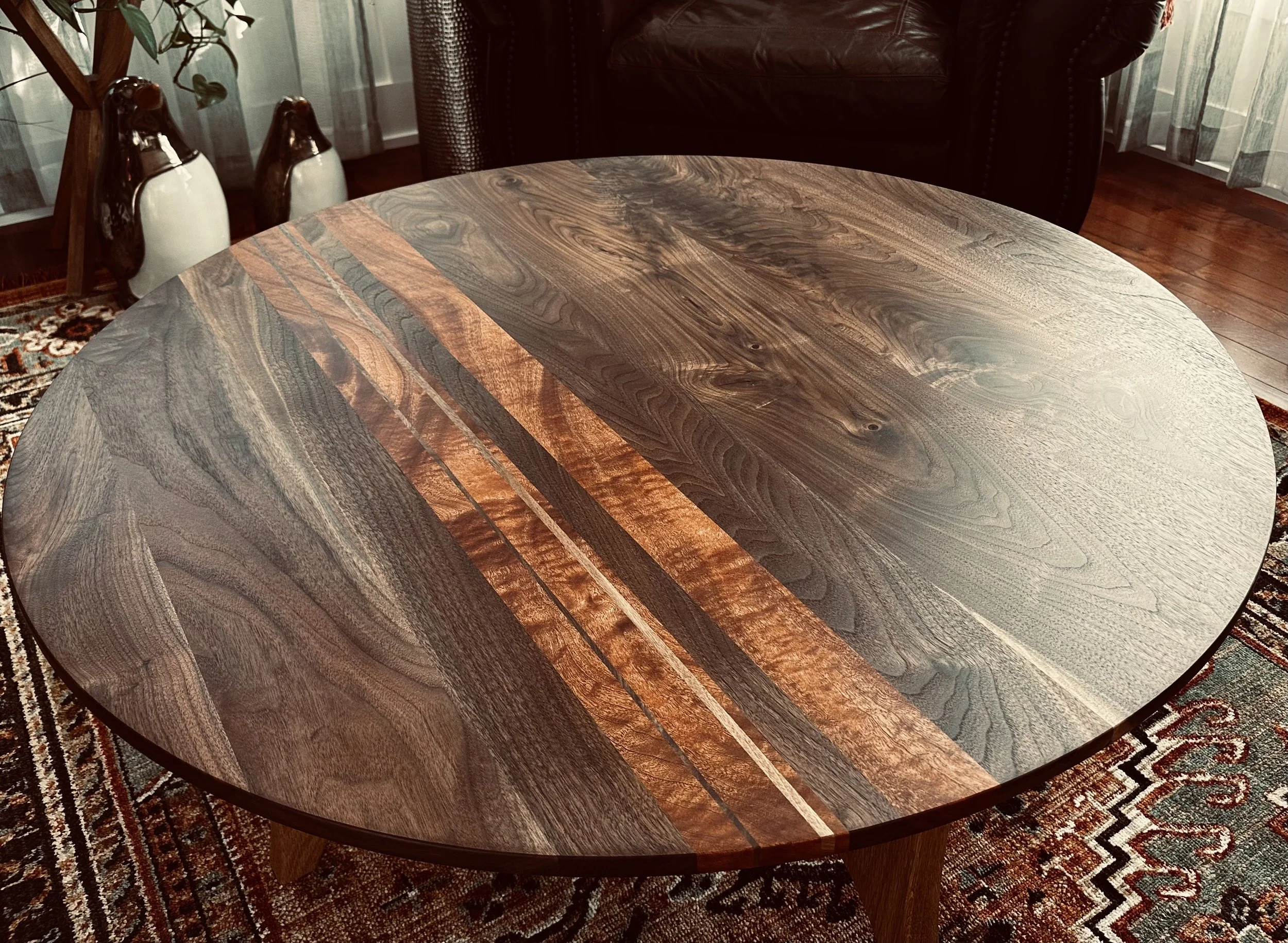
Happy accident on this build. Crazy grain patterns that somehow went together, and a decent showcase of how many different figures walnut gives you. White oak base for contrast and because white oak takes a beating.
Why I Keep Reaching for It
Walnut is probably 25 to 30 percent of what comes through my shop in a given year. Not because I chose to be a walnut guy, but because walnut keeps being the right answer for the work I do.
Joinery is the first reason. The Festool Domino cuts mortises in walnut that look like they were planned at the factory. Tight walls, clean walls, no blowout on the back of the cut. I've built more walnut table bases than any other species, and that's the reason. Joints come together without fighting. Squeeze-out cleans off with a wet rag. Glue lines disappear into the grain.
Sanding is just as kind. Walnut runs from 120 to 220 without grain raising or swirl marks eating my time. That matters when a table top is 80 inches long and one visible swirl kills the piece.
But the real reason I keep reaching for walnut is the finish moment. Raw walnut after milling has a quiet look to it. Muted brown, dust from sanding, pencil lines, tool marks. It doesn't announce itself. The grain and figure are all there, but they're asleep. Then the first coat of oil goes on and the wood comes alive. Deep chocolate, purple streaks, gold undertones, chatoyance that moves as you walk around the piece. None of that is the oil. All of it was already in there. The oil just reveals what the wood already was. I've finished hundreds of walnut pieces and that first-coat moment still gets me every time. It's genuinely the best payoff in the shop.
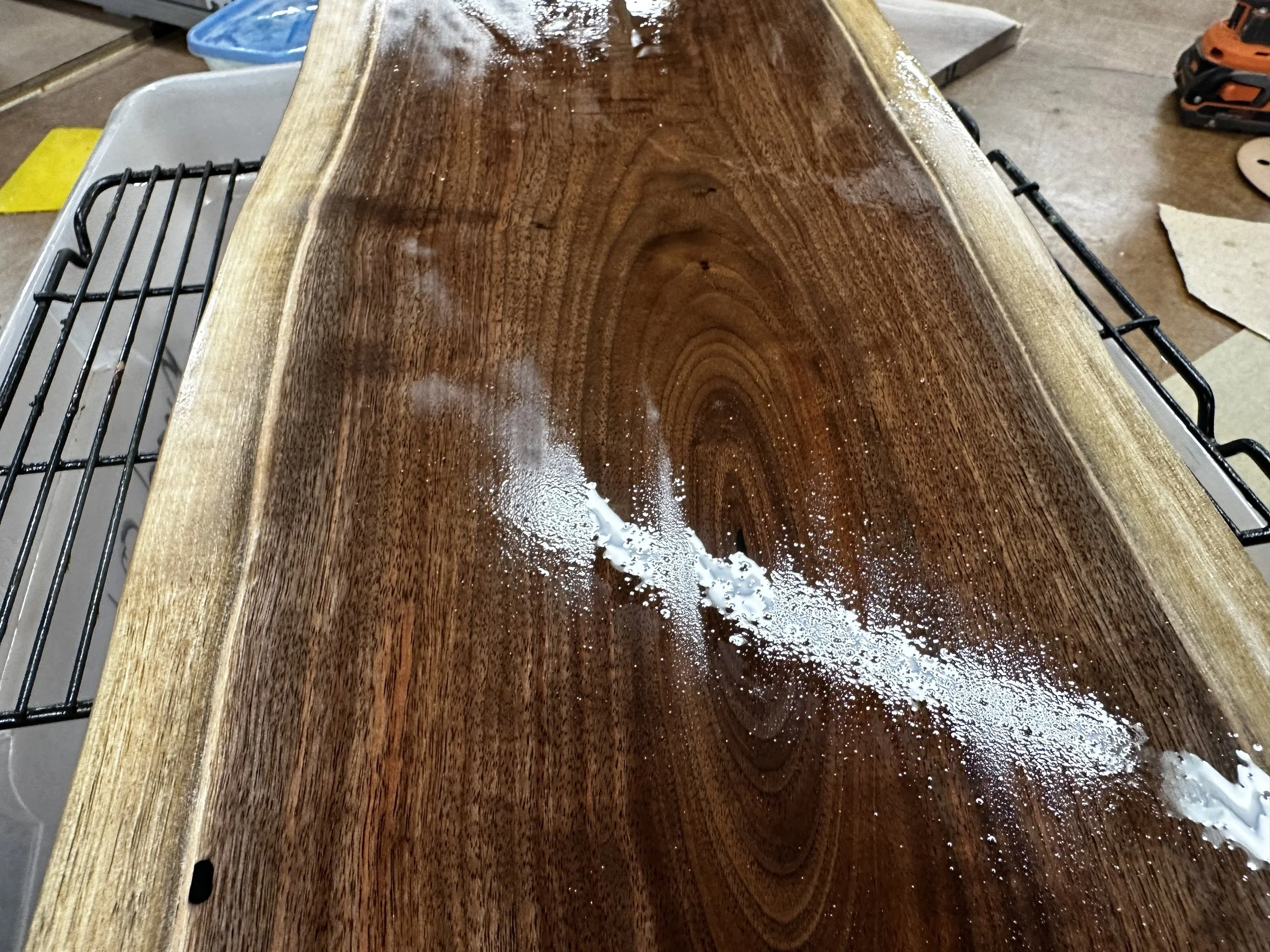
The oil moment. Same board looked gray and unremarkable thirty seconds earlier.
The Walnut Wildcard
Walnut doesn't work the way white oak does. With white oak, the cut is the question. Flat, quarter, rift. Spec the cut or you don't get what you expected. Walnut is almost always flat sawn. Walnut trees don't grow straight enough for quarter sawing to make economic sense, so the mill just doesn't cut it that way.
So where white oak asks how it was cut, walnut asks a different set of questions. These are the variables I learned to ask about the hard way. They change everything about what you actually get.
Steamed vs air dried. Commercial American walnut lumber is almost universally steamed during the kiln process. The steam drives the color of the sapwood (the lighter cream-colored part) closer to the color of the heartwood (the dark chocolate part). That's why most walnut looks relatively uniform. Air dried walnut is a completely different experience. The sapwood stays cream, the heartwood stays chocolate, and the contrast between them is dramatic. Air dried walnut also retains more color depth, more purple, more gold. The catch is it costs two to three times more and you have to buy it from a specialty mill. Or you take your chances on Facebook Marketplace with the guy who swears it was in his barn for 25 years. Every week, same guy, different post, still selling the same pile, huh? Most designers have never actually seen true air dried walnut and assume the steamed version is what walnut looks like. Starbucks isn't buying air dried.
Sapwood versus heartwood economics. For most of walnut's history, sapwood was considered a defect. Premium lumber meant all heartwood, and any cream streak in a board reduced its value. That flipped in the last ten years. Designers started specifying sap to heart contrast as a design feature, and now the lumber that used to be cheaper can command the premium. It depends entirely on the look you want. If you want uniform chocolate, spec all heartwood. If you want the natural contrast or the live edge story, spec sapwood and heartwood together.
American versus European walnut. This is the biggest price gap most designers don't know about. American black walnut runs roughly $10 to $20 a board foot depending on grade. European walnut, Claro walnut, English walnut, and Bastogne walnut can run $40 a board foot and up, sometimes way up for figured stock. They look different too. European walnut tends to be lighter, with more figure variation, and it has a different character when finished. "Walnut" on a spec sheet is not a species. It's a starting point.
Figure. Most walnut is plain-sawn flat grain, and that's what ends up in 90 percent of walnut furniture. But walnut produces some of the most spectacular figured lumber in the world. Curly walnut, quilted walnut, crotch walnut, burl walnut. Serious walnut buyers hunt for these. The pricing on a curly walnut slab versus a plain-sawn flat grain slab isn't double, it's ten times. If you want something that looks like nothing else, figure is where you get it, but you can't spec it conventionally. You have to go look at individual slabs.
The lesson: "walnut" is a vocabulary word, not a spec. What you actually want needs four or five additional data points before a mill knows what to send you.
Sorting walnut for a build. Grain match, color match, figure match. The boring part that nobody posts about.
Finishing Walnut
Walnut was made for oil finishes. That's not a marketing line, that's chemistry.
Walnut is one of the oiliest domestic hardwoods. The wood itself contains natural oils that make it flexible, rot resistant, and resistant to insect damage. When you put an oil finish on walnut, you are not adding oil to a dry wood. You are adding oil to a wood that already has oil in it. The two meet in the grain and behave like they belong there. The color deepens, the chatoyance starts moving, and the surface ends up looking like polished stone instead of coated wood.
My two go-to finishes on walnut are the same ones I use on almost everything else. Osmo Polyx-Oil and Rubio Monocoat. Both are oil and hardwax finishes that soak into the wood rather than sitting on top. On walnut, both look unreal. Osmo brings out more warmth. Rubio feels more natural, more like the wood without any finish at all, just protected. I pick between them based on the project.
One specific trap to know about. The pigmented Rubio tints that look incredible on white oak do not work the same way on walnut. Rubio White 5%, the finish that made the closet project look like a boutique hotel on rift sawn white oak, goes chalky and cold on walnut. The walnut is too dark to accept the white pigment cleanly. It ends up looking like the wood got dusty instead of like a designed finish. If you want to lighten walnut, there are walnut-appropriate tints (Smoke, Havana, Chocolate Intense) that work with the wood's existing color. Always spec them with a sample first. I've spec'd Rubio tints on walnut expecting one thing and ended up with something I had to strip and redo, which is a painful education on a four figure slab.
Water based finishes are less of a problem on walnut than on white oak because walnut doesn't have the same tannic acid reaction. You can use waterborne polyurethane on walnut without the gray blotchy reaction you get on oak. But even without that problem, I still don't recommend it. Oil finishes let walnut look like walnut. Poly on walnut looks like walnut wearing a plastic bag. The wood deserves better.
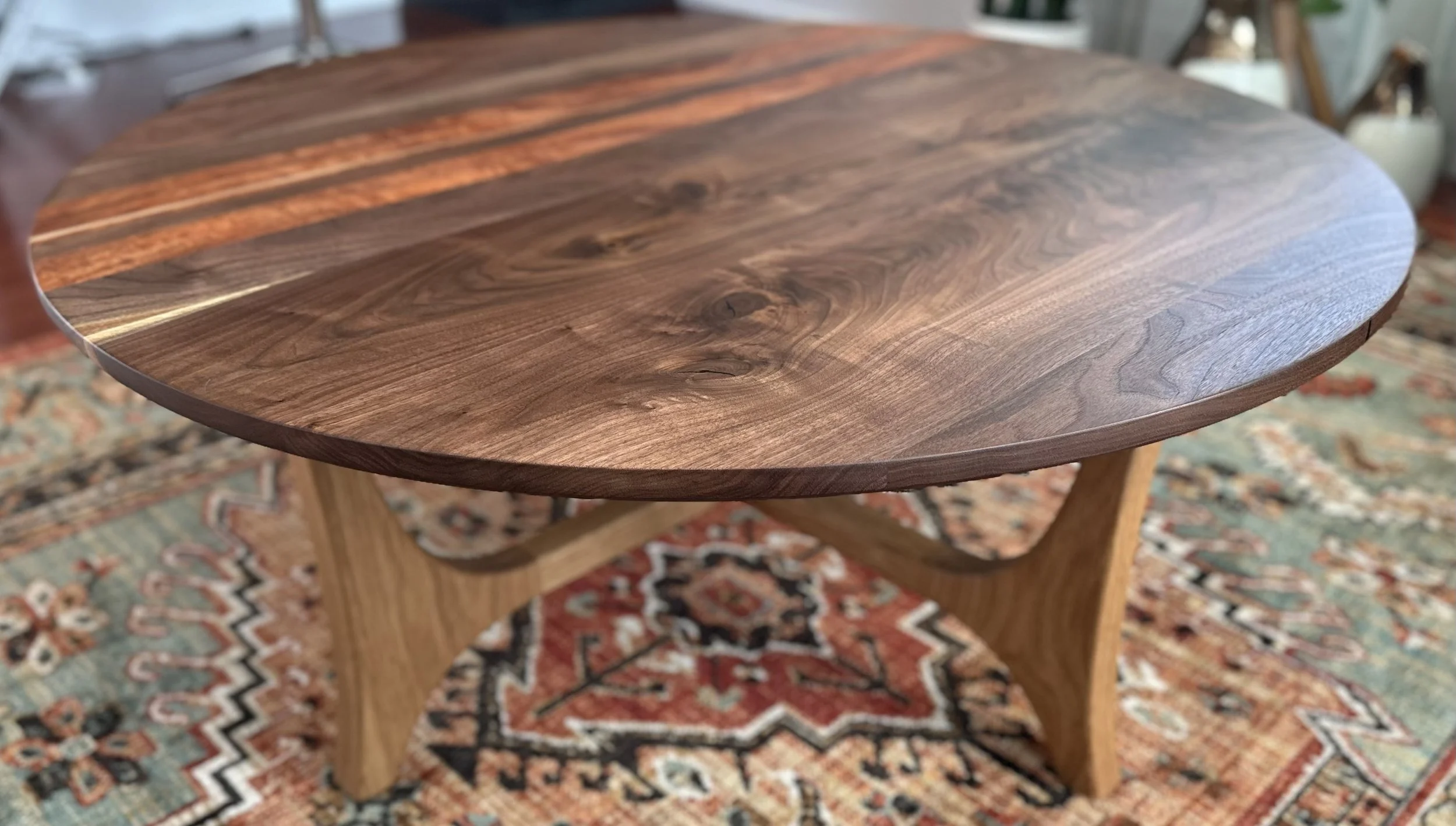
Same table from the side. Walnut on top, white oak holding it up. The contrast is a species decision, not a finish decision. That's a design lever that doesn't get talked about enough.
Back to the thing I opened with. Walnut lightens. I noticed it, I went deep trying to understand why, and I ended up running a live test on it.
The science first. Walnut gets its dark chocolate color from compounds in the wood that are chemically unstable when hit with UV light. Over time, those compounds break down, and the color shifts. Oxygen speeds it up. The result is the lightening toward amber and honey that happens to every walnut piece sitting in a naturally lit room. It isn't a finish failure. It's the wood itself changing.
The question is whether you can slow it down. Most oil finishes offer a little UV protection, but not much. Some polyurethanes have UV inhibitors, but you're trading the look of the wood for marginal protection, which is the wrong trade. Blacktail Studio's Nano product is a ceramic coating marketed specifically for UV protection on finished wood. Cam, the guy behind the brand, started producing it because he got tired of watching walnut epoxy river tables fade in his own shop.
The Milo table is my live test. It's a walnut piece sitting next to a window in my house. Direct afternoon sun three to four hours a day, which is basically the worst case UV exposure for an interior wood surface. I finished it with Rubio Monocoat and then applied the Blacktail Nano coating on top of the cured finish. I'm documenting it with photos on a regular schedule so I have a real record, not a vibe.
What I'm seeing so far. The table has lightened some, but noticeably less than the comparable walnut pieces in my house without the Nano coating. I don't have laboratory-grade data yet. What I have is empirical evidence from a wood obsessive with too many walnut reference pieces scattered around his house. I'll keep updating as the test continues.
If you want to see the Milo table up close, the walnut slab story, and where I've landed on the Nano question, the full story lives here.
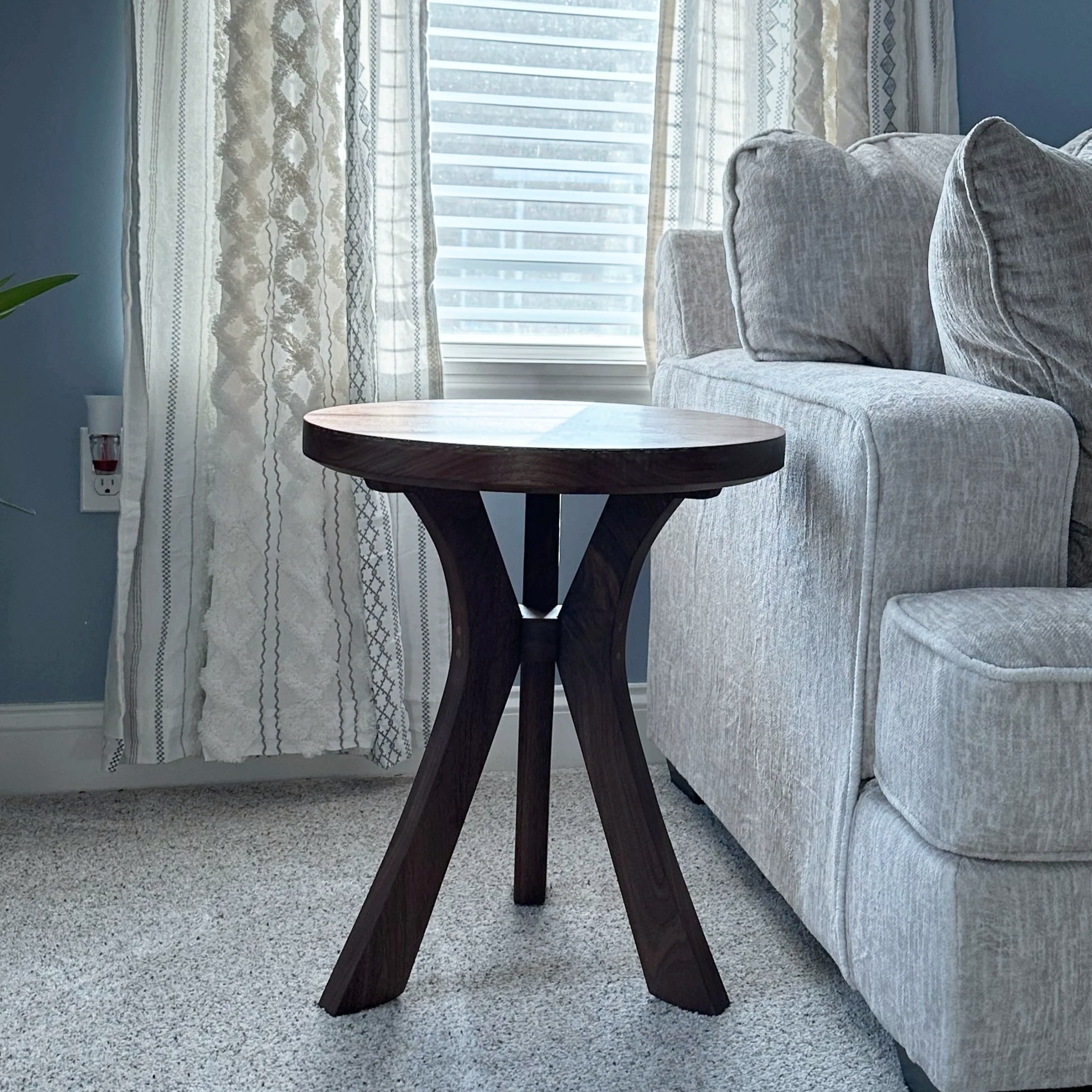
The Milo table. Currently living next to a window as a live UV experiment.
Where Walnut Will Humble You
I love this wood but that doesn't mean it's the right answer for every project. Here's where it will humble you.
It lightens. Already covered. If you or your client wants rich chocolate walnut and the piece is sitting in a sunlit room, plan on that color being a ten year rental, not a permanent feature. Blacktail Nano can help. UV window film helps. Keeping the piece out of direct sun helps most. But some lightening is coming either way.
It's soft. Walnut's Janka hardness rating is 1,010. For reference, white oak is 1,360, hard maple is 1,450, and the exotic species designers sometimes compare walnut to, like teak or wenge, are way harder. Walnut dents. It shows gouges from forks, keys, pet claws, anything harder than it is. A walnut dining table is going to show life in a way a maple or white oak table won't. For some clients that's a feature. For others, finding out their eight thousand dollar dining table is taking damage after three months of normal use is a brutal surprise. Have the conversation up front.
Matching is an art. Walnut has enormous natural color variation, and adjacent boards from the same log can look like different species. When I build a large piece from walnut, the lumber sort and grain match can take hours. I lay out the boards, rearrange them, flip them, rearrange again, until the transitions look intentional. That hidden labor is a big chunk of why bespoke walnut furniture costs what it does. If you're spec'ing walnut for a 12 foot conference table, either budget for the matching time or spec a species that matches itself. Or sometimes it goes the other way on you and works out anyway. The coffee table earlier in this post is a happy accident. Crazy grain patterns that had no business agreeing with each other, and somehow they did, and the build ended up being a decent showcase of how many different figures walnut actually has. Know whether you're going for matched or for range before the quote goes out. Or let the wood decide.
Supply is tightening. Thousand cankers disease and the walnut twig beetle are pressuring American walnut populations in parts of the country. Not at crisis levels yet, but the trend is concerning, and the price trajectory over the last five years looks a lot like white oak's trajectory in the decade before it went luxury. If you build a lot of walnut, you're watching the supply story closely whether you want to or not.
The dust and the juglone. Walnut dust, like most fine hardwood dust, is a respiratory irritant. Running walnut through the table saw or a big sanding session without dust collection and a respirator is a rough experience. Juglone, the compound that makes walnut trees literally toxic to other plants growing near them, is present in the wood too. Contact dermatitis on sensitive skin happens, not to everyone, but often enough. It's happened to me after touching it too much, but I have sensitive skin, so go easy in the comments. I run a Bosch dust extractor on any tool that's generating walnut dust, a respirator on big sessions, and I still end up with famous walnut boogies. Take it seriously.
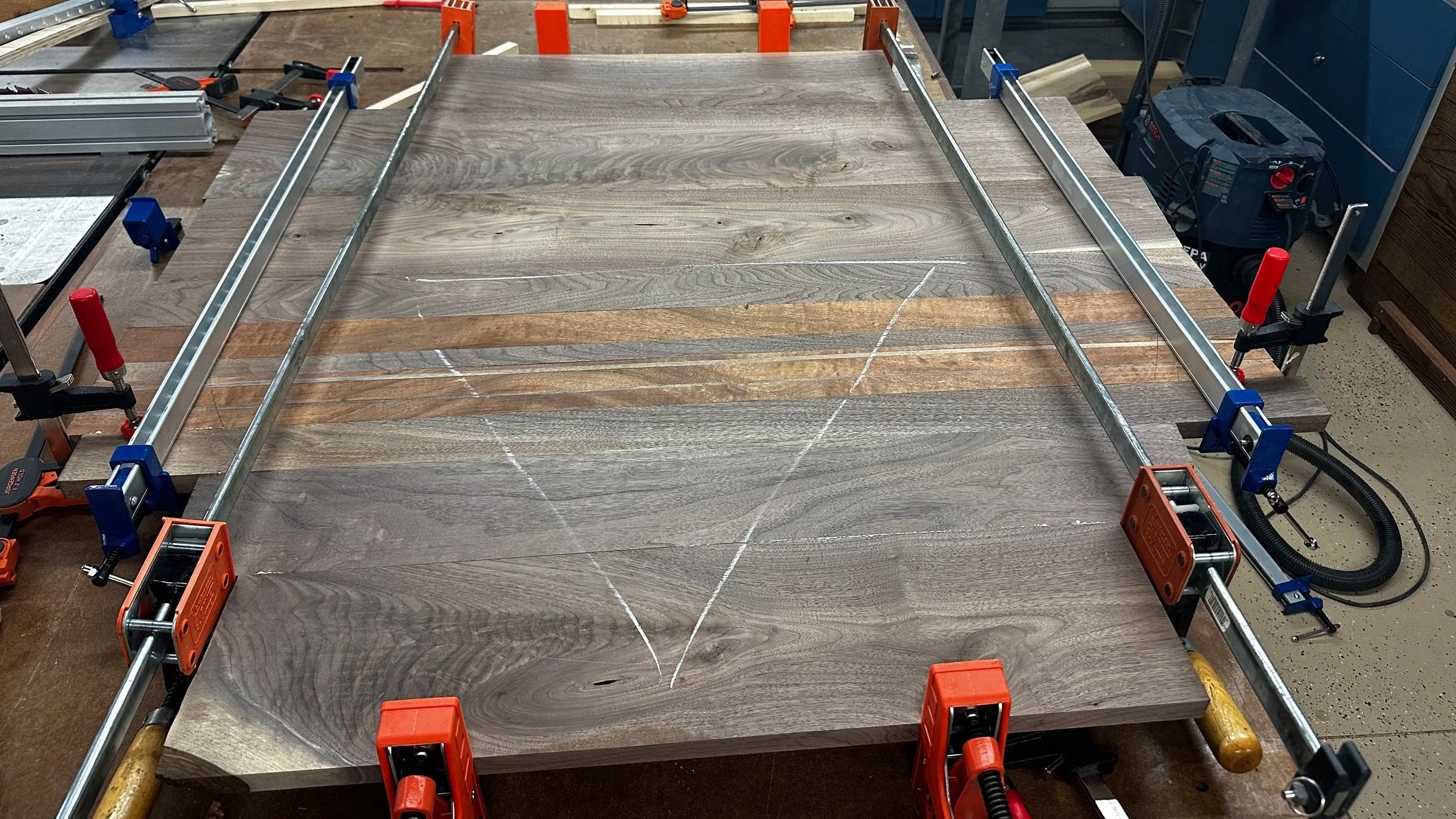
A walnut glueup in progress. The chalk lines are the labor nobody sees in the finished piece.
Still the Standard (For Now)
Walnut earned its place at the top of the American hardwood stack by being the right answer for the best designers of the last century. It's still the right answer more often than not. The combination of workability, finish behavior, and visual warmth is genuinely hard to match. If you want one wood species to carry a high-end residential project and you don't want to think about it too hard, walnut is still the safe bet.
But safe bets change. White oak has come back hard in the last ten years, and the reasons it's back are the same reasons walnut's reign might be less secure than it looks. White oak takes modern oil finishes almost as well as walnut does, runs harder on the Janka scale, doesn't lighten the same way, and is currently priced at parity with walnut despite historically being cheaper. I've been thinking about that comparison a lot lately. It's probably its own post.
For now, walnut is still the crown. Spec it knowing what you're spec'ing. Finish it right. Plan for the ten year light shift. It'll still be the wood I reach for when a project needs to feel unmistakably high end. If you want to see the counter-argument, the white oak deep dive is here.
For everything I use in the shop on walnut projects and beyond, you can see the full list on my Tool Room page.
Products Referenced in This Post
Osmo Polyx-Oil: my go-to oil finish on walnut and most furniture projects. The warmth it brings out on walnut is hard to overstate.
Rubio Monocoat: single coat oil finish. Natural 0% on walnut lets the wood be itself. Skip the pigmented whites on this species.
Festool Domino: the loose tenon joinery system I use on almost every walnut table build. Clean mortises, tight joints, fast work.
Blacktail Studio Nano Protection: UV protective ceramic coating. Available direct from Blacktail Studio. I'm running it as a live test on the Milo table.
Bosch Dust Extractor: HEPA filtration for the fine walnut dust and juglone particles. Respiratory protection matters with this species.
Affiliate Disclosure: This post contains affiliate links. If you purchase through these links, I may earn a small commission at no additional cost to you. I only recommend products I personally use in my shop.
Keep Reading
White Oak: Why Woodworkers Keep Reaching for It. The counter argument. Why white oak has come back hard in the last ten years and what that means for walnut's crown.
The Festool Domino Changed How I Build Furniture. Why loose tenon joinery cut my build times in half, and how the Domino performs specifically in walnut.