
Track Saws vs Table Saws: When I Reach for the Track Saw First
At the center of my shop is a Grizzly 5hp table saw and tucked away under that saw’s outfeed table is a Makita track saw and a few extra sections of track. Which do I prefer…well that’s a tricky one. The table saw runs about 85 percent of the work in my shop, same as it probably does in most shops. However, I’m not getting any younger and one thing I learned is that there is a tool for every job. Unless you own a $30,000 slider to cut your plywood sheets, a track saw is way better than trying to wrestle sheet goods by myself without ending up in traction. I am in the middle of a project right now that has put both tools through it, so this is a good time to talk about when each one earns its place.
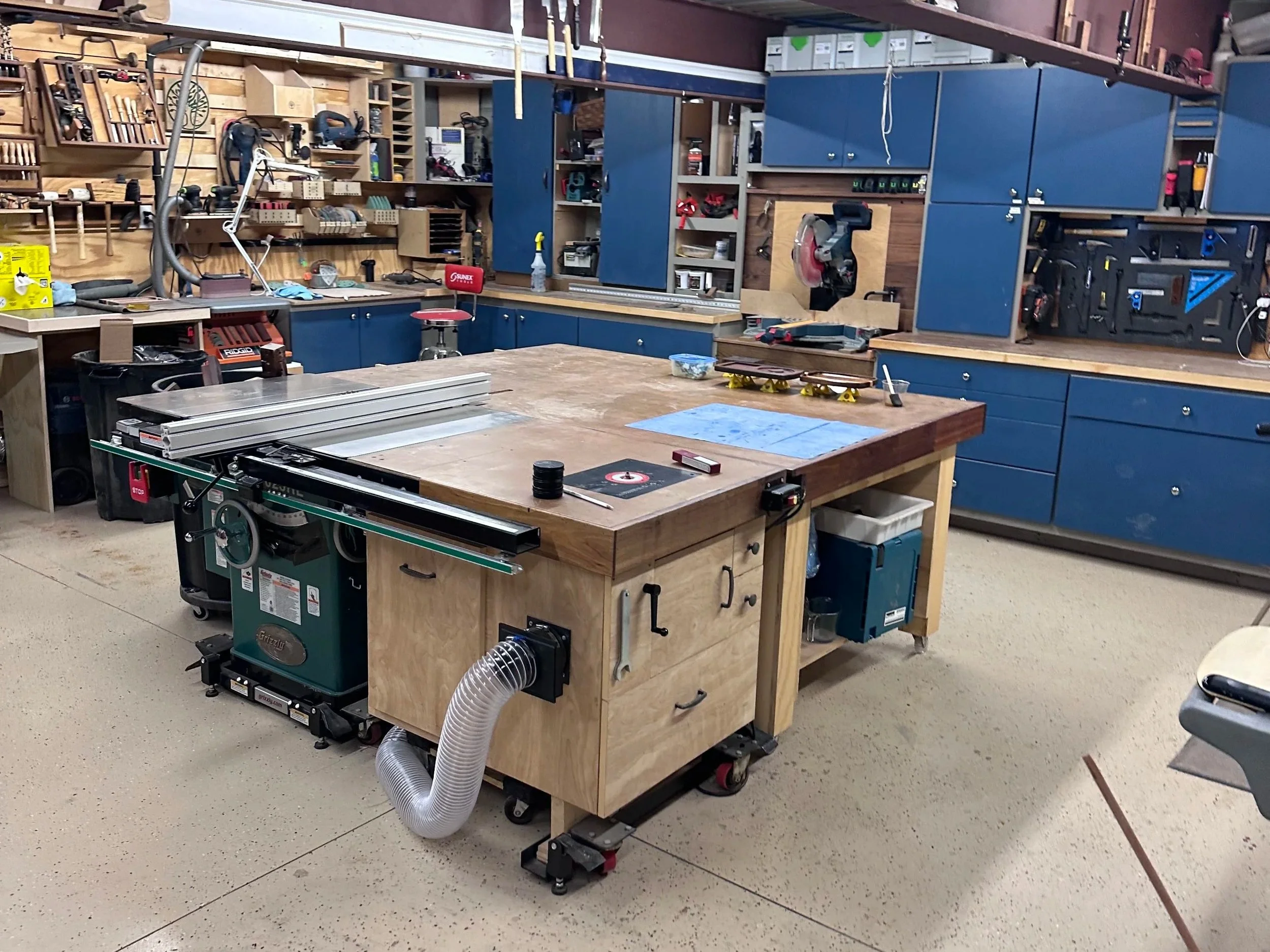
My shop. The Grizzly lives in the center, the Makita lives under the outfeed table. That tells you something about how often each one moves.
30 Sheets of Rift Sawn White Oak
The project is a 250 square foot custom closet in rift sawn white oak, architectural grade, double sided plywood that runs $800 to $1,000 a sheet depending on where you source it. So far I have broken down 18 sheets of one inch stock and 12 sheets of half inch, which puts the material bill somewhere around $25,000 to $30,000 before I make a single cut. And that’s just the plywood, I haven’t even got to the ¼ sawn lumber yet. That is a lot of money to be feeding through a saw, and it changes how I think about every single cut.
If you want to know why I went with white oak on this project, I get into that here.
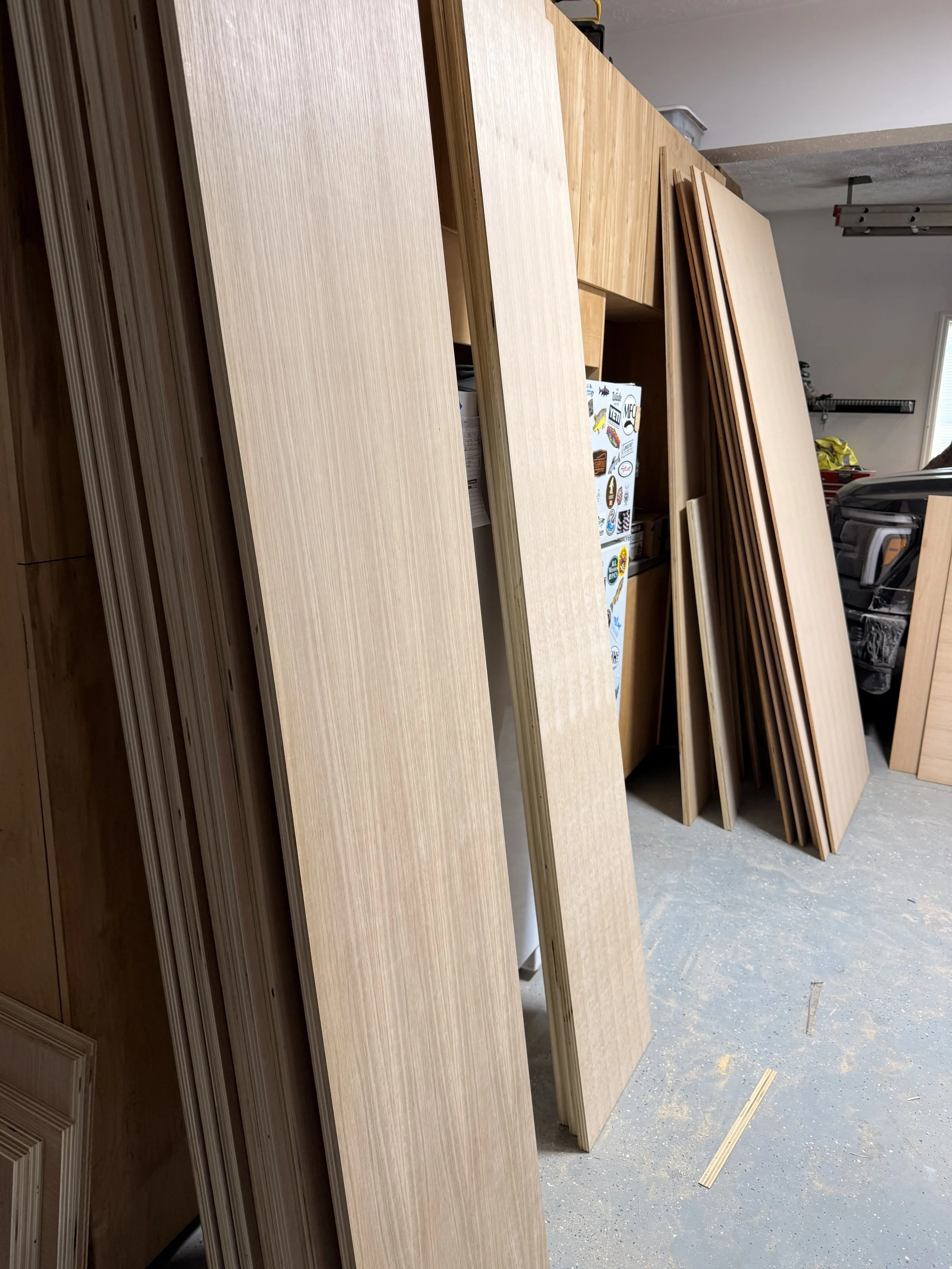
30 sheets of rift sawn white oak at $800 to $1,000 a sheet. There is no margin for error on this material.
Why This Job Landed in the Garage
My shop isn’t small for my level of woodworking, but it sure as hell isn’t big enough either, it’s about 800 to 900 square feet and every inch is taken. There is definitely no room to wrestle full 4x8 sheets of one inch white oak around without bumping into something, knocking something over or tearing my shoulders apart. Those sheets weigh close to 90 pounds each, and getting one onto a table saw by yourself in a tight space is not happening when you have 30 of them to get through.
So that means we are parking outside for a few weeks because my garage is now the shop annex, and I need to move quick, it gets cold in western PA and the wifey doesn’t like busting out the ice scraper because I got jammed up on space.
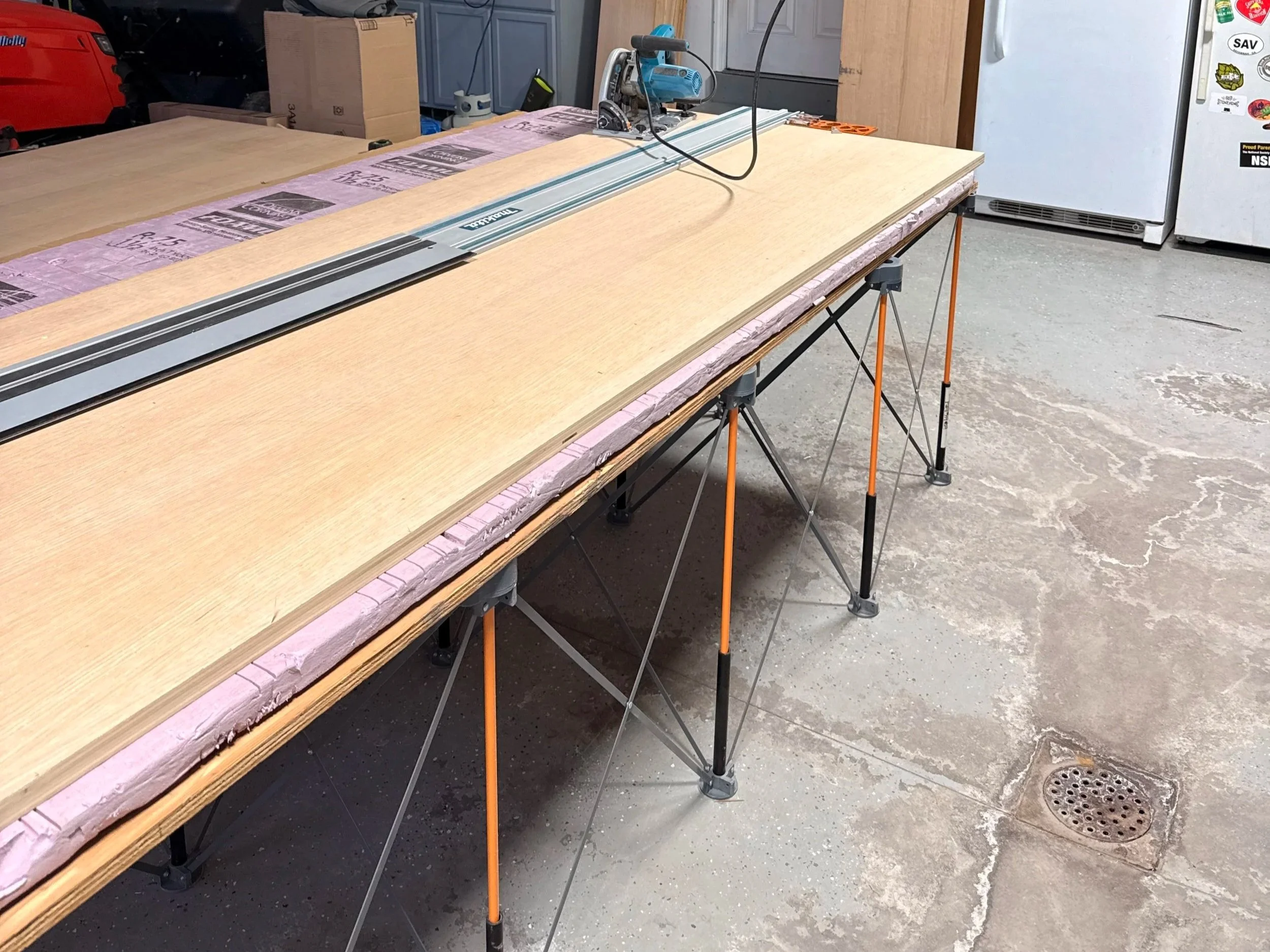
Bora Centipede, a sheet of plywood, inch and a half of rigid foam. That was the cutting station for 30 sheets of white oak.
I set up a Bora Centipede, threw a sheet of plywood across it, put a piece of inch and a half rigid foam on top, and that was the cutting station. Sling a sheet of white oak onto the foam, set the rail, run the Makita through it. Sheet after sheet, by myself for most of them, pulling my wife in when I was too gassed to wrestle another 90 pound panel onto the stack alone.
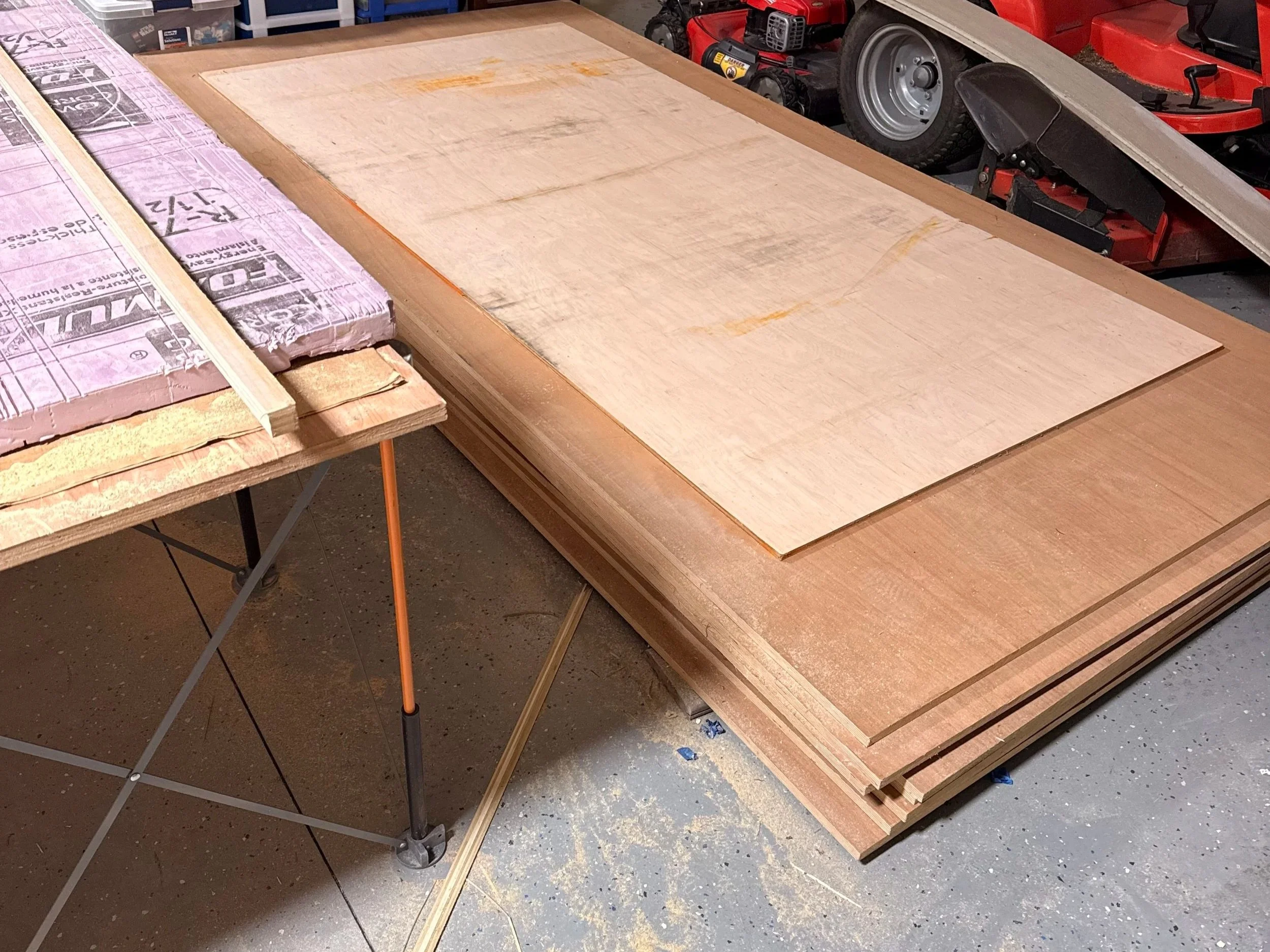
Full sheets ready to go on the Centipede to break down. The garage became the sheet goods shop for this build.
Every cut came out clean with consistent, splinter free edges on rift sawn white oak, which is a species that will let you know immediately if your blade is dull. This was a three blade project by the way and I like the Freud ones for this. I didn’t get far with my original blade then I tried a fox something and then the Freud. All worked well, some lasted longer.
Rough Cuts in the Garage, Precision Cuts in the Shop
Most of those track saw cuts were not final dimensions. I was breaking full sheets into rough sized panels that I could actually carry downstairs to the shop, and once the pieces were manageable they went to the table saw where I could dial them in against the fence.
That is how the two tools work together on this project. The track saw handles the breakdown where space and material size make the table saw impractical, and the table saw handles the precision work once everything is sized down to something I can actually control.
The Jointer Problem
The other place the track saw earns its keep is straightlining rough lumber. I have a six inch jointer with about 5 feet of table…total. It handles short stock fine, but anything longer than about five and a half feet and I am out of luck. An 8 foot board of rough sawn white oak is not going across this six inch jointer no matter how many passes I make, unless it’s already got a decent edge.
So I set the track saw rail along the edge I want to establish, rip a straight reference edge with the track saw, then take it to the table saw and rip the opposite edge parallel off the fence. That alone saved me from buying a bigger jointer, which would have been $3,500 to $6,000 and taken up floor space I do not have.
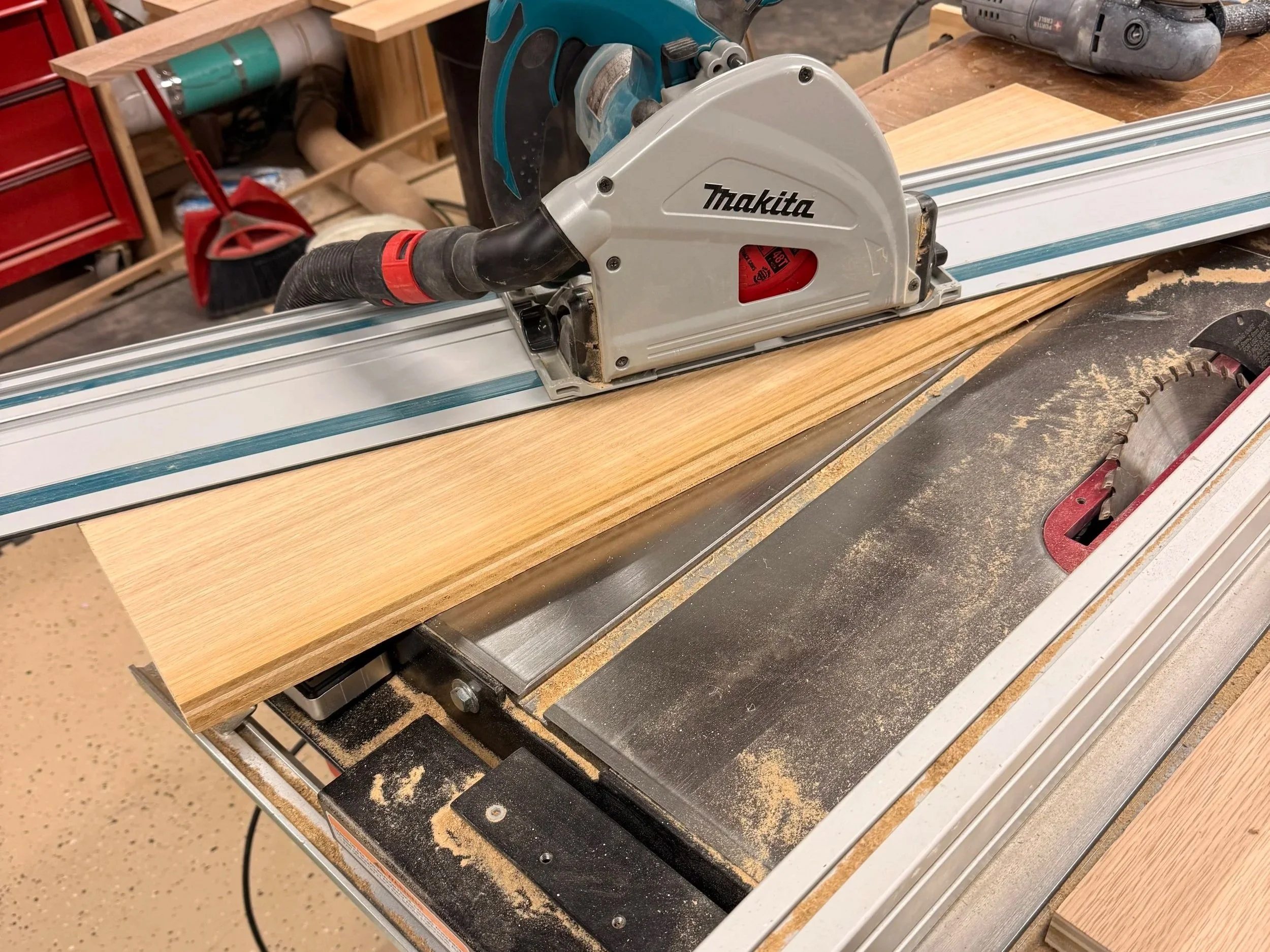
The Makita sitting on the Grizzly table saw ready for the next rip cut
What the Table Saw Still Does Better
My Grizzly handles everything that needs a fence and precision repeatability. When I need 20 pieces of 1 3/4 inch white oak to trim these cabinets out, I set the fence once and run them through, and there is no version of that workflow where a track saw makes sense. Could you do it, sure, I do a lot of dumb things…mostly out of necessity. I won’t judge you if you don’t judge me.
Dado stacks are another thing the track saw cannot touch. Dados and rabbets for joinery, drawer bottoms, tenons on a sled, anything where a jig references off the miter slot or the fence is work for the table saw and always will be.
Batch work in general goes to the table saw. Eight table legs to identical width, 40 pieces of trim to the same dimension, any cut where I need a stack of identical parts. Setting a track saw rail for every cut in a run is not practical when the fence does the same job without resetting anything.
Thin strips are another one. On the track saw there is nothing supporting the back side of the track, so it wants to see-saw and you lose your cut line often.
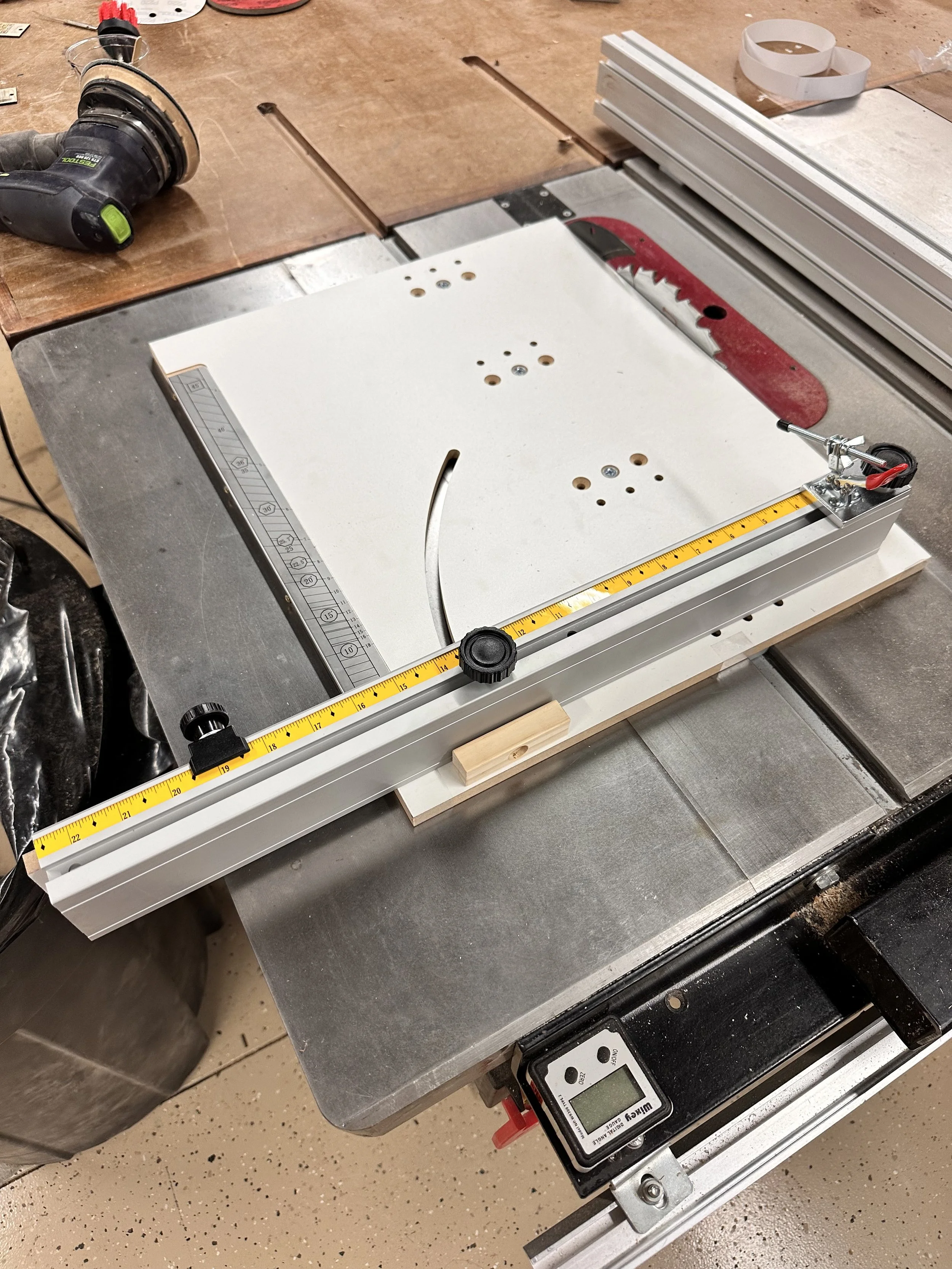
The Grizzly with the crosscut sled. Anything that needs a fence and repeatable precision goes here.
The Cuts Where Either Works
Some cuts could go either way and it comes down to what is more convenient. Breaking down panels that are already a manageable size, say under 48 by 48. The table saw can handle anything the track saw can do, it is just that the track saw is a little easier to manage in certain situations when the stock is unwieldy.
For most of those I reach for the track saw because the setup is shorter. Half the time my outfeed table has something on it from another project and I do not feel like clearing it off. Set the track, make the cut, move on. A lot of the time it is just step one anyway, rough cut to get close and then the table saw for the final dimension.
Dust Collection Is a Real Difference
This does not come up enough in these comparisons. My table saw runs through the shop’s main dust collection, a Grizzly 2HP collector into a Oneida Super Dust Deputy XL cyclone separator with a six inch trunk and four inch drops, and even with all of that I am still sweeping up after a heavy ripping session. Table saws throw dust everywhere, under the table, behind the fence, across the floor. It fills the pockets of my apron so I can lose more pencils.
The track saw connects to a Bosch dust extractor through the integrated port and the dust capture is not even in the same conversation. I can rip sheet after sheet and the work surface stays mostly clean. When I am already managing fine dust from sanding and routing, having one tool that handles its own mess matters more than people think.
If You Are Setting Up a Shop, Which One First
Depends on what you build. If most of your work is furniture with repeated joinery, identical parts, and jig based cuts, the table saw comes first because nothing replaces it for that work. If you are building cabinets, closets, built ins, or anything that starts with sheet goods, a quality track saw will get you further than you expect. I am 30 sheets into this white oak closet and the results have been as clean as anything the table saw would have produced on those same cuts. Cleaner, actually. On the table saw the blade spins upwards, so when you are dealing with one sided plywood you want the good face down. But then you risk scuffing the good side on the table. You can tape your cut lines to reduce tear out on the upside, but that is a pain in the ass and takes time when you have 30 sheets to get through. On the track saw the plywood sits on the foam, the track holds down the edge, and the blade plunges into the wood. The cuts just come out cleaner.
If you can swing both, get both. They handle different stages of the same work.
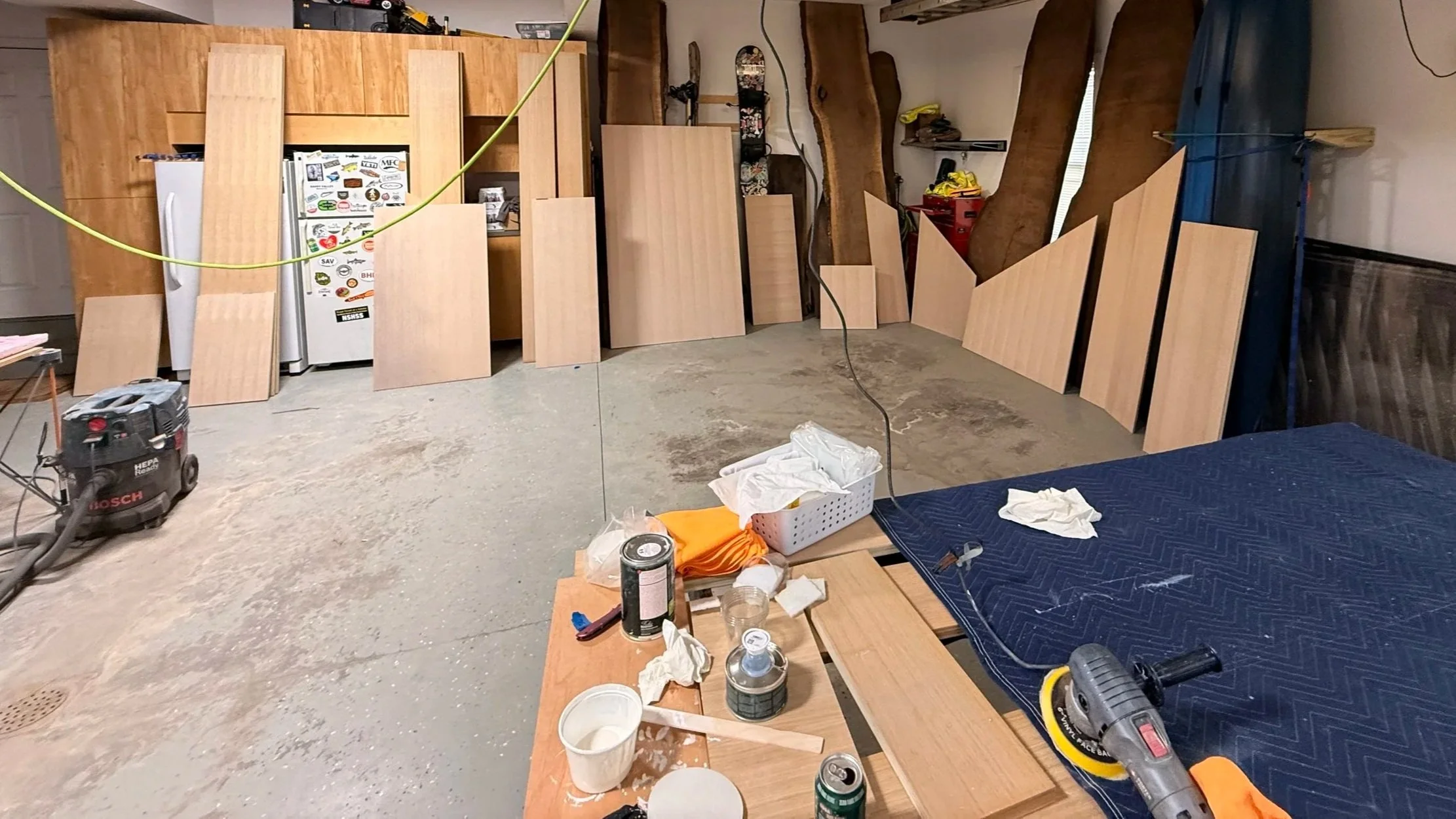
Garage wide shot with cut white oak closet panels standing upright, live edge slabs on the wall, and Rubio with other finishing supplies on the temporary workbench
Products Referenced in This Post
Makita SP6000J Plunge Circular Saw Kit with Two 55 in. Guide Rails — the track saw and rail setup I used for the closet build, comes with two rails you can join for full sheet rips
Bora Centipede 4x8 ft Portable Work Station — the folding work station I set up in the garage for the sheet goods breakdown
Freud LU79R006M20 160mm Thin Kerf Ultimate Plywood and Melamine Blade — the blade I settled on for the closet build, lasted the longest of the three I went through
FOXBC 6-1/2 Inch Track Saw Blade 56T 20mm Arbor — one of the blades I tried before landing on the Freud
Bosch VAC090AH 9-Gallon Dust Extractor — the dust extractor I run with the track saw, auto filter clean and HEPA filtration
Affiliate Disclosure: This post contains affiliate links. If you purchase through these links, I may earn a small commission at no additional cost to you. I only recommend products I personally use in my shop.