
Mixing Wood Tones in a Room
A Woodworker’s Guide
You’ve probably heard that you are not supposed to walk under ladders and you certainly shouldn’t go swimming for thirty minutes after you eat and god forbid if you spill salt, I don’t think anyone has survived that. Yet for all the conviction behind these warnings, nobody ever explains why… you’re simply expected to obey, no questions asked.
And if you do slip up you best knock on wood to guarantee your safety. At least I have plenty of that laying around.
It turns out designing with wood has some of the same kind of rules. You should never mix warm and cool tones. You better not put dark wood in small rooms. And you should never have more than three species of wood in the same room. Everybody repeats these “rules” but Ive never had anyone explain to me why…until now.
This issue surfaces all the time in my own house. Im always wanting to build furniture for a space and I rarely make anything out of a single species of wood. My wife wants a room where everything matches (matchy-matchy…right dear), same wood, same tone, same family. She says it’s calming. I like the contrast, different species, crazy grain patterns doing different things makes me happy. So, we’ve been going back and forth on this one for decades and neither of us has moved an inch. Which is why, despite her having a crackpot woodworker living in the house, we still have some of the same old, cheap, crappy furniture from 15 years ago.
But we need to get past this, so we paid an ungodly amount of money and got an interior designer to tell us I’m right, hopefully.
Our daughter Abbie got her degree in architecture and is now finishing her master’s at Arizona State in Interior Architectural Design. She’s got the chops to settle this dispute once and for all. So, when we finally dragged her into it, she did what any good designer does with difficult, stubborn clients. She took a look at these rules we were arguing about and dissected them one at a time.
Rule One: Never Mix Warm and Cool Tones
The first rule says wood tones come in two flavors. Warm ones that pull red, gold, or orange and cool ones that pull gray, green, or silver. They aren’t supposed to share a room. You get to pick one and you’re supposed to live with it.
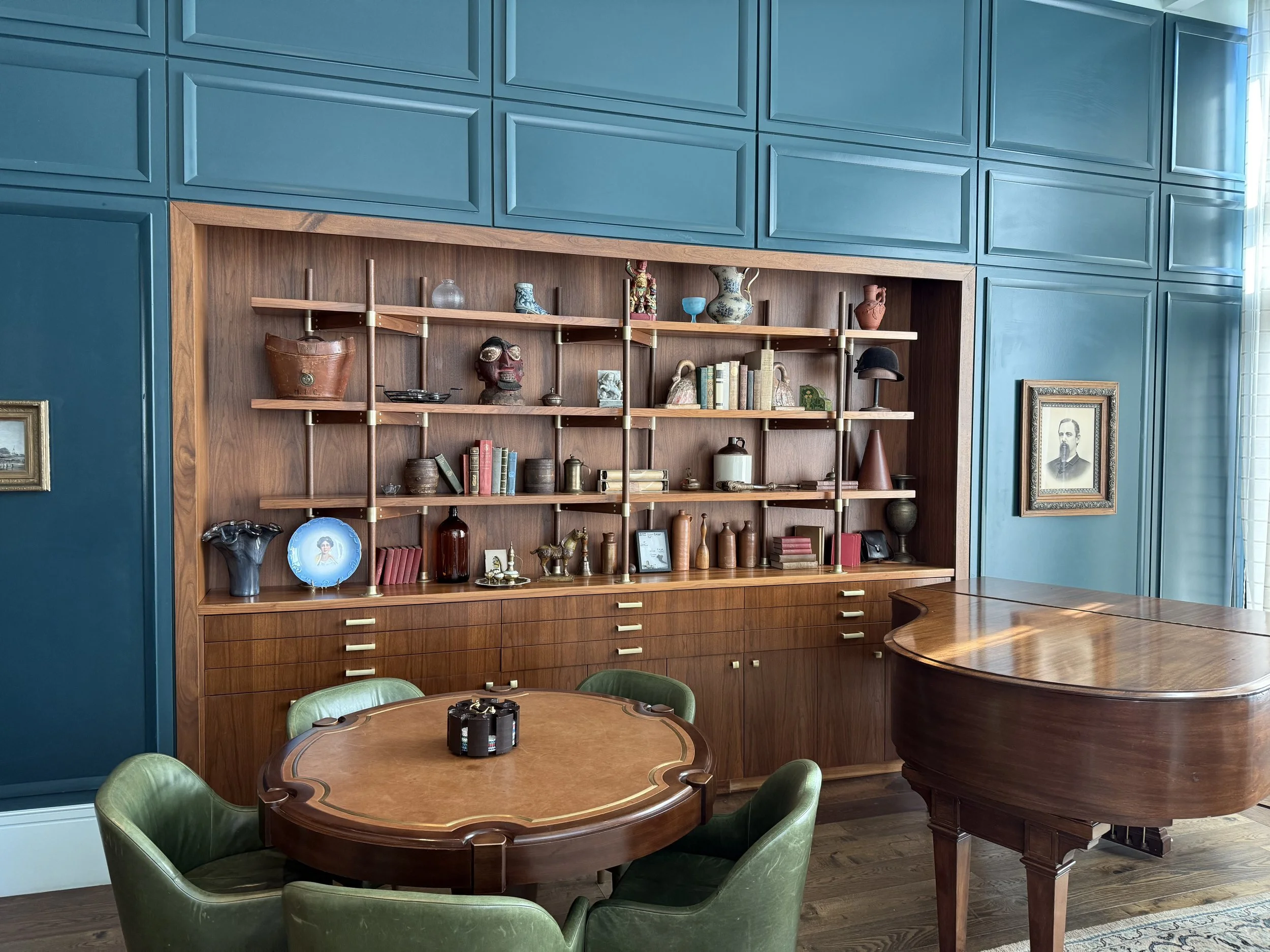
Cool teal walls, warm walnut shelving, mahogany piano, green velvet chairs. Rule One falling apart in real time.
However, this rule falls apart the minute you walk into a living room that you actually like. For example, if you watch HGTV or any woodworking YouTube furniture builder you see warm and cool tones together everywhere, especially lately. But is this just a fad, let’s find out.
Abbie says she learned the opposite. “A room has a visual temperature, and it depends how formal you want it to be. Cool tones lean formal and warm tones feel cozy. If your living room feels too cool you balance it by bringing in contrasting materials. Contrast is how you fix a room, not how you break one, depending on the design you’re going for.”
Never mix warm tone woods with cool
I’ve heard this one before, but it’s not anything I’ve ever learned formally. It’s just been one of those things you hear people say. I disagree with it completely. Look at how warm walnut can be. Look at how cool white oak or maple can get with a certain finish. That pairing shows up in so many rooms that just work. Same with paint. Most kitchens now contrast the island against the perimeter, or the base against the uppers. Nobody calls that clashing.
— ABIGAIL SHAW
Rule Two: Don’t Put Dark Wood in Small Rooms
The second rule says dark wood in a small room makes it feel smaller, so you keep small rooms light and save that walnut for somewhere bigger.
That advice got written in the 1990s when every magazine was pushing light-and-airy as the only way a room could be. Meanwhile, some of the best small rooms anywhere are wrapped in dark wood. Old libraries. Victorian studies. Speakeasy booths (making a hot comeback). They aren’t cramped. They’re intimate, which is most of what small rooms are actually good for, intimate and cozy.
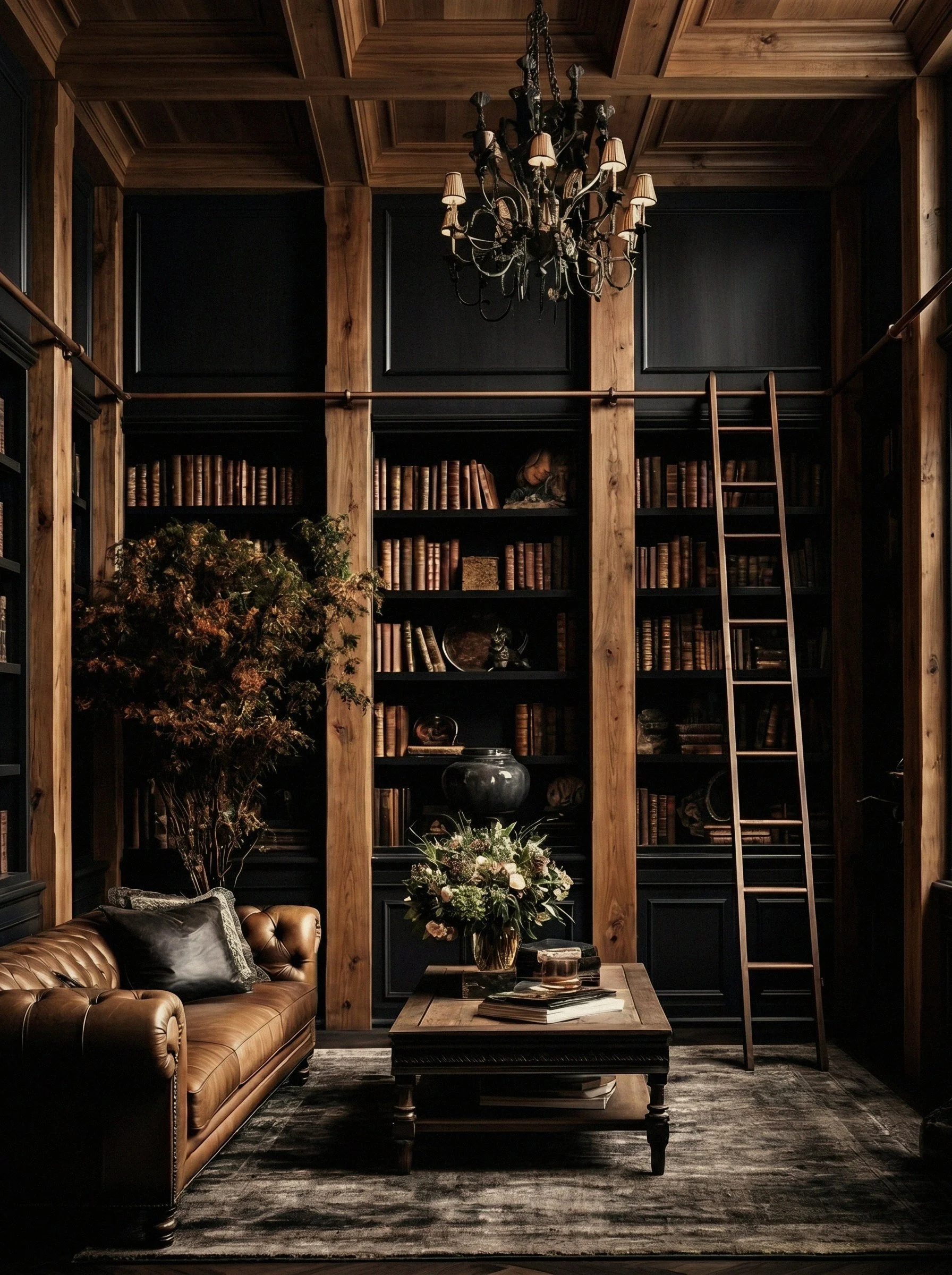
A small dark-wood library. Intimate, not cramped. The opposite of what Rule Two predicts.
This one bugs me. It assumes every small room is trying to feel bigger. That’s not true. Dark academia is blowing up right now and it’s literally small rooms wrapped in dark wood. Libraries, studies, reading nooks. Sometimes small rooms can have a huge impact if done correctly.
— ABIGAIL SHAW
Rule Three: Three Species Max in a Room
The third rule says three species max per room, anything past that gets chaotic. This is the one you hear the most, the one most people actually break without meaning to.
If you live in your house and it’s not just a museum, you’ve probably had to replace pieces of furniture, especially if you have kids or pets. Over time you end up mixing and matching woods and sometimes it works and sometimes not. Weve done that and now we have rooms with four or five different woods. But are we sinners? Mid-century living rooms used four or five wood tones across furniture, flooring, and built-ins and people love it. The three-species rule doesn’t seem to land here.
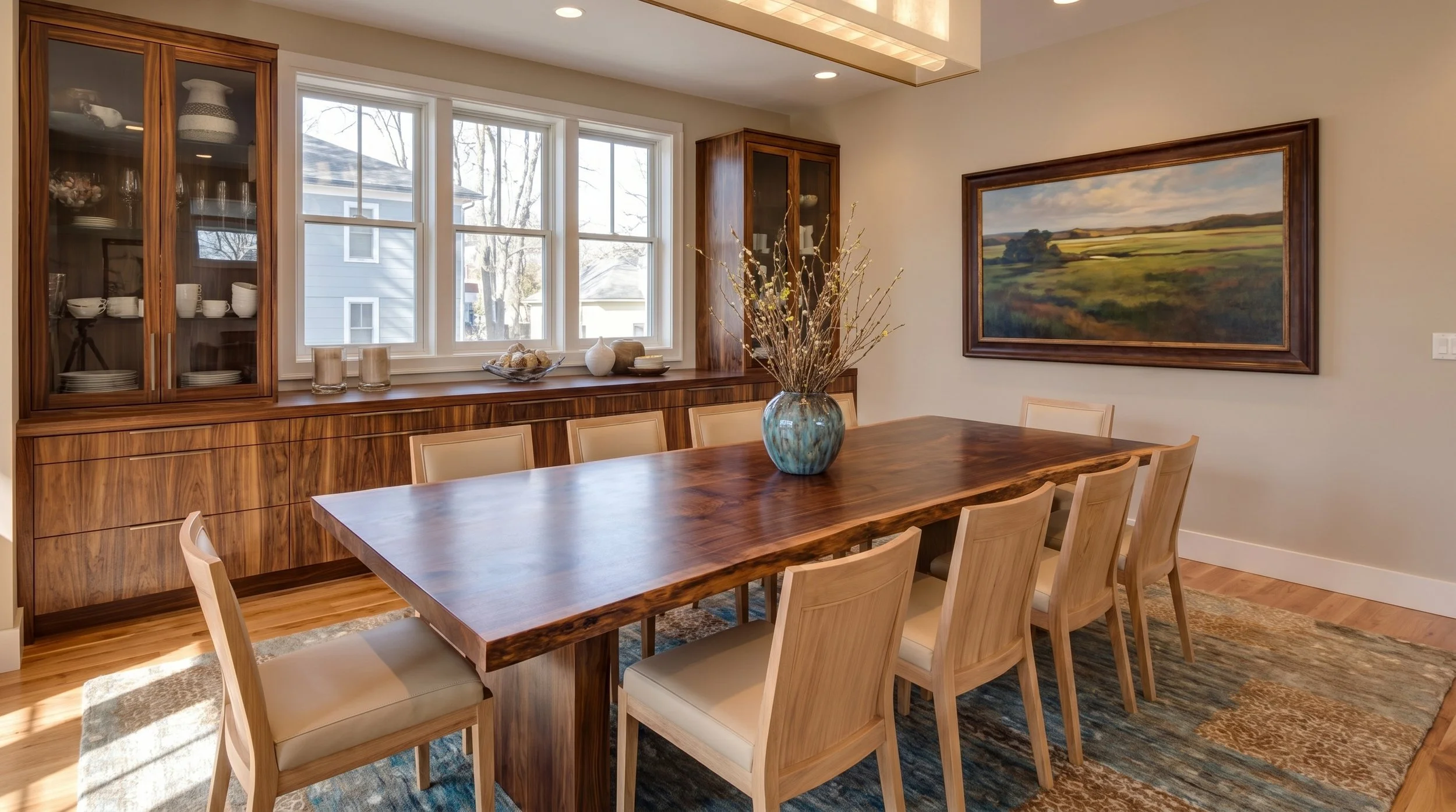
Walnut table, walnut sideboard, light wood floor, pale wood chairs. At least four species in one room, working together.
One trick that makes the mixing easier: when a darker species shows its sap wood, the cream-to-dark transition inside a single board acts like a built-in bridge to a lighter species somewhere else in the room. Walnut with sap wood streaks next to a hickory floor or an ash chair reads as intentional, not accidental.
“Three species only.” This is the one I’ve heard the most, honestly. And it may actually be a good starting point. But it’s not a rule. Open up just about any style magazine and you will see rooms using four or five woods, a walnut table, oak floors, teak accents and maple shelving, and you probably wouldn’t even realize it. A lot of kitchens easily have three to five when you count flooring, cabinets, island, and seating.
— ABIGAIL SHAW
Circling back to see whose right. What my wife and I thought we were fighting about was something else entirely. Which brings us to the breakfast table.
We have the most embarrassing breakfast table that I have ever seen. Its literally a big lots special and the chairs are so bad its laughable. We are used to it at this point, but I know people come into our home and whisper “doesn’t he build wood furniture?” The reason its still there is because we cant agree on the wood. I want to build it with osage orange (the monkey ball tree) with a walnut base. Osage can be a loud golden yellow and it ages down to amber-brown over a few years. Some of the most beautiful gun stocks are made from it. Walnut is the warm neutral that holds the piece together. This table would be freaking gorgeous. But my wife thinks it would clash with the hardwood floors in the room. Personally, I don’t give a shit about the floors, but I’m probably wrong. I want a table that’s beautiful and osage and walnut together is beautiful.
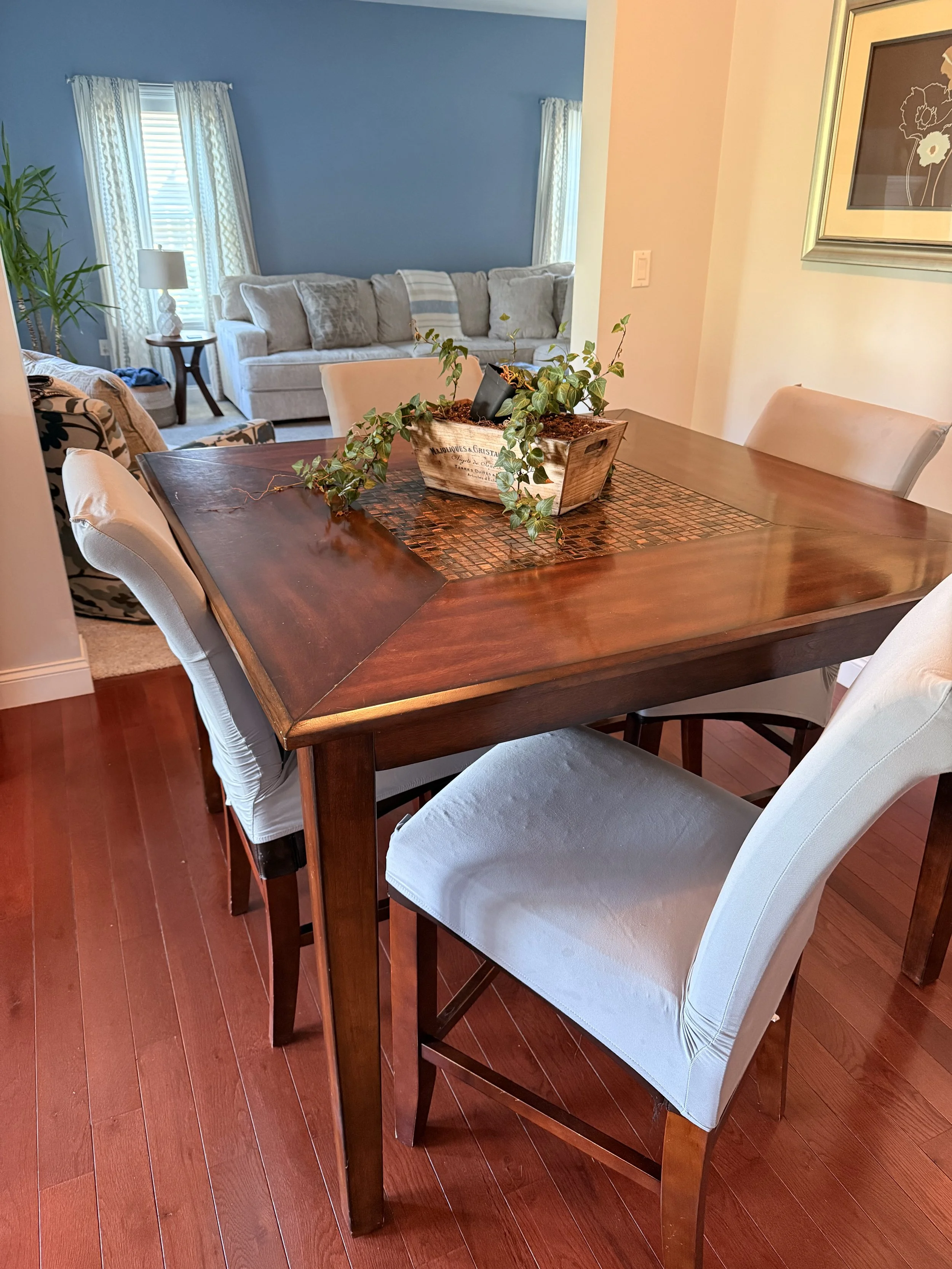
The current breakfast table. Big Lots wood, white slipcover chairs, cherry-stained oak floor. The table that needs replacing.
The floors are three-inch oak plank stained cherry, warm and reddish. She’s not wrong to worry, but are we concerned about the same thing?
Abbie mapped it out for us in roughly fifteen seconds.
“Mom isn’t necessarily wrong, and Dad isn’t necessarily right,” she told us. “All three woods are in the warm family, so temperature isn’t the issue. What she’s probably struggling with is the visual weight. When Dad showed us what osage looks like, it has a lot going on especially as a live edge with epoxy. Walnut looks smooth and chocolatey. BUT…the walnut might be exactly what’s needed between the floor and the table top.”
She walked us through it as two variables. The first is undertone compatibility. That’s what all three rules are fumbling at, and it’s what most blog advice on mixing wood tones gets half right. The second is visual weight. Nobody names it because it’s harder to teach. Some woods are loud. Figured maple is loud. Osage is loud. A slab of zebrawood is so loud it eats its own room. Other woods absorb visual weight instead. Walnut does that job constantly. Quartersawn white oak does it too. Build compatible rooms by thinking about undertone first, visual weight second.
On the breakfast table, you know I’m going to build it anyhow, but like my mahogany and bubinga poker table, it will probably just have to live at someone else’s house.
I think what we all learned from this, and what my parole officer keeps telling me, “Rules are there for a reason but you seem to just use them as suggestions”. It turns out I’m not entirely wrong when it comes to design. So maybe the table will live in the breakfast room after all, sounds like a nice family project this summer. Rules are kind of like guidelines but we like what we like so there’s nothing wrong with breaking the rules so long as it makes you feel good. Just be careful you don’t get carried away, that’s where it starts to go south.
That expert we paid ungodly sums of money to? well…ASU tuition isn’t cheap but she’s definitely worth it, and I have a feeling she will do just fine in her career, knock on wood. You can check out her portfolio of work at abbieshawdesign.com And if you were curious about that poker table we talked about, it got relegated to our camp, covered in beer, and dust and yet it is still the nicest piece of furniture there.
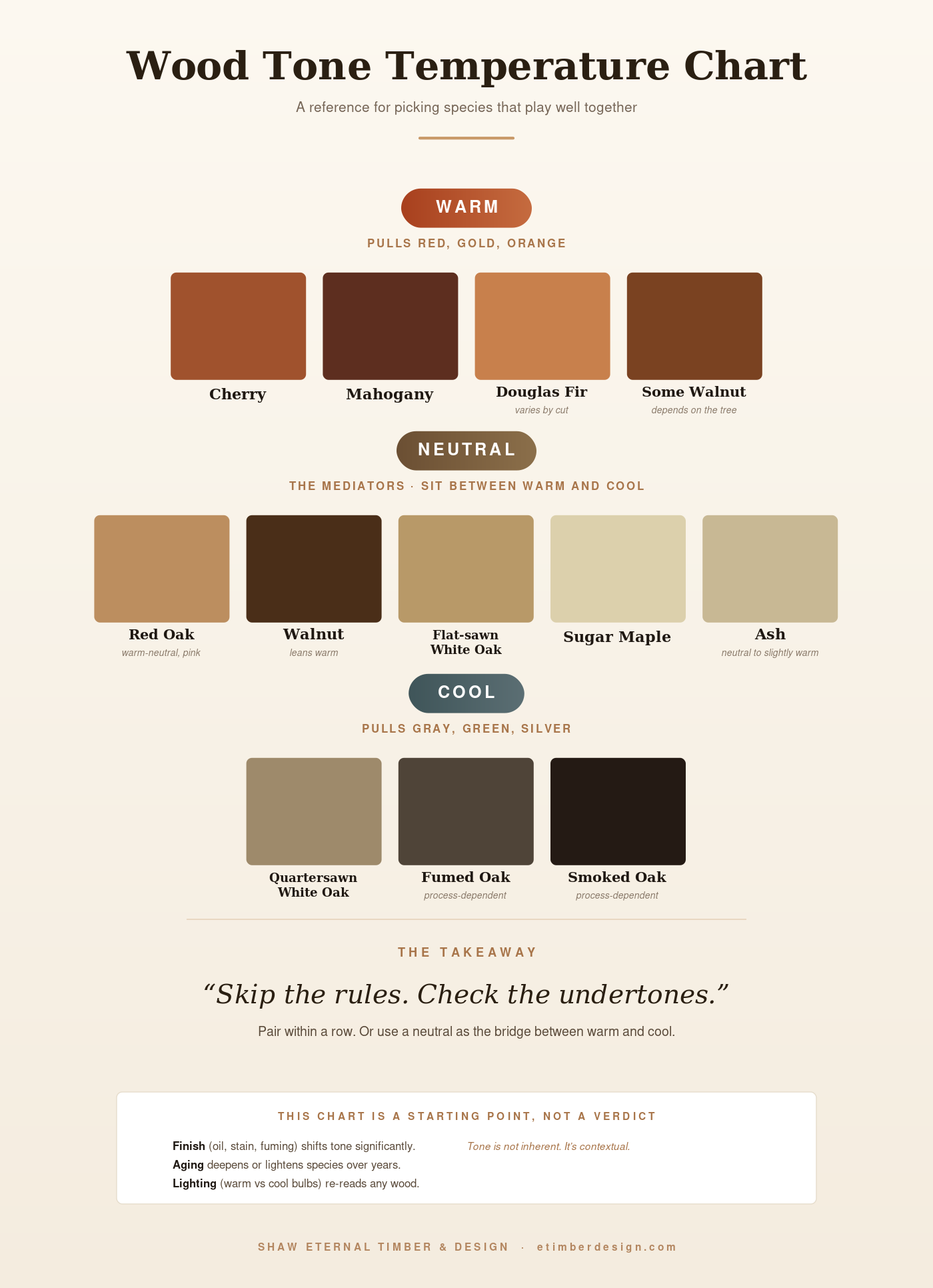
A reference chart for picking species that play well together. Pair within a row, or use a neutral as a bridge between warm and cool.
About the Design Commentary
This post includes design commentary from Abigail Shaw, a Masters of Interior Architecture candidate at Arizona State University, with an undergraduate degree in architectural studies from the same school. She is also our daughter. Her portfolio is at abbieshawdesign.com.